Top 10 Private Label Activewear Manufacturers
Looking for a reliable private label activewear manufacturer? Explore 10 manufacturing partners and supplier candidates for fitness brands, compare sourcing considerations, and learn how to evaluate minimum order quantities, sampling, customization, quality control, and production costs.
Leading private label activewear manufacturers and sourcing candidates include FreeFeel Gym Wear, Ohsure Wear, Zega Apparel, Tack Apparel, Affix Apparel, Argus Apparel, Billoomi Fashion, Lefty Production Co., The Evans Group, and Create Fashion Brand. The right partner depends on verified manufacturing capabilities, minimum order quantities, fabric options, sample quality, production lead times, and your brand's budget and customization requirements.
What Is Private Label Activewear Manufacturing?
Private label activewear manufacturing is a production arrangement in which a clothing manufacturer produces fitness apparel that is sold under another company's brand name.
Depending on the supplier and the agreement, private label production may involve adding a brand logo and custom labels to existing garment designs, modifying established patterns, or developing entirely new products from technical specifications.
Products can include leggings, sports bras, yoga sets, gym shorts, running apparel, compression clothing, performance tops, and athleisure collections.
Private Label vs. OEM vs. ODM
| Model | Meaning | Typical Use |
|---|---|---|
| Private Label | Products are sold under the buyer's brand. | Branding existing or customized apparel. |
| OEM | Manufacturing according to buyer-approved specifications. | Brands with established designs or tech packs. |
| ODM | Supplier-supported design and product development. | Brands seeking development assistance. |
These models often overlap in practice. A supplier may provide private label branding together with OEM production or ODM design support. Buyers should confirm exactly which services are included in the quotation.
Top 10 Private Label Activewear Manufacturers to Consider
The following list combines activewear manufacturing companies and broader apparel development partners worth evaluating. It is a supplier research shortlist, not a ranking based on independently audited performance or verified customer satisfaction.
Before placing an order, confirm each company's current services, factory relationships, production capabilities, minimum order quantities, and commercial terms directly.
1. FreeFeel Gym Wear — China
Best considered for: Startup and growing activewear brands seeking factory-direct OEM, ODM, and private label manufacturing support in China.
FreeFeel Gym Wear provides custom activewear development and manufacturing services for independent designers, e-commerce businesses, wholesale buyers, and established sportswear companies.
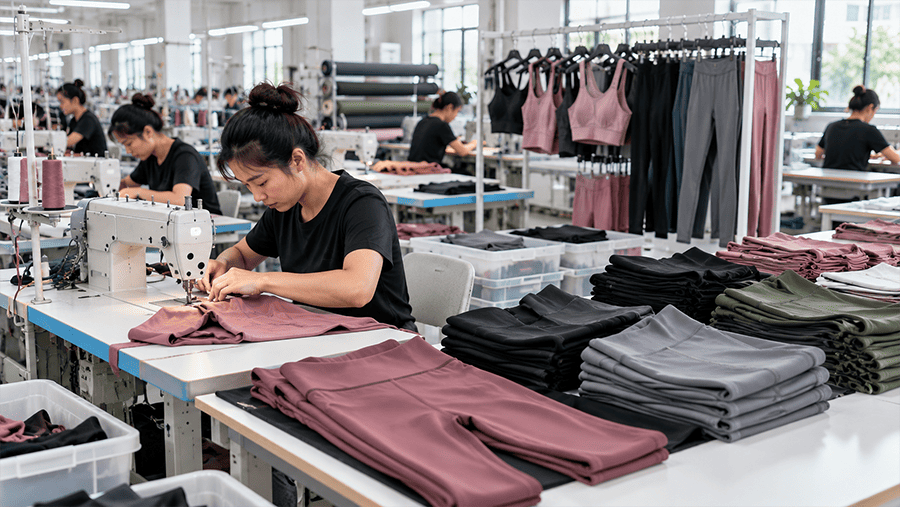
Its factory operation has more than 15 years of apparel manufacturing experience, an approximately 3,000-square-meter production facility, and more than 100 workers. Overall production capacity is approximately 1,000 pieces per day, depending on garment complexity, materials, and scheduling.
FreeFeel's standard MOQ is 100 pieces per color per style, with size mixing normally supported within the same color and style. Sample development typically takes approximately 7–10 days after all required specifications are confirmed.
- OEM, ODM, and private label development
- Standard MOQ: 100 pcs/color/style
- Sample development: approximately 7–10 days
- Fabric selection and sourcing support
- Custom fit, colors, logos, labels, and packaging
- Fabric, in-line, and final quality inspections
Specially developed fabrics, custom dyeing, trims, and packaging can change minimum order quantities or development requirements. Confirm bulk schedules and final prices with the factory.
Explore FreeFeel's OEM manufacturing services and private label services to understand available development options.
2. Ohsure Wear — China
Best considered for: Brands evaluating a China-based activewear OEM and private label manufacturing partner.
Ohsure Wear is an activewear-focused manufacturing business offering a relevant sourcing option for brands developing custom fitness and sportswear collections.
Buyers exploring Ohsure Wear should discuss product development requirements such as fabric selection, garment fit, logos, private labels, packaging, sampling, and bulk production.
The most important step is to obtain a project-specific quotation that confirms the available customization options, production arrangement, MOQ, lead time, and inspection procedures.
Official website: https://ohsurewear.com/
Exact production capacity, order minimums, certifications, and delivery terms should be confirmed directly with Ohsure Wear.
3. Zega Apparel — USA
Best considered for: Brands researching custom clothing development and private label garment sourcing.
Zega Apparel is a custom apparel manufacturing name to investigate when comparing garment customization and private label clothing options.
Activewear buyers should ask about experience with stretch fabrics, performance garment construction, sports bra development, leggings, and technical fit requirements.
Verify the current production location, available services, garment-specific MOQ, and sampling arrangements before shortlisting.
4. Tack Apparel — USA
Best considered for: Businesses comparing custom apparel production and brand development services.
Tack Apparel is another supplier candidate for brands seeking customized clothing manufacturing arrangements.
For fitness apparel projects, request examples of relevant garment construction and clarify whether cutting, sewing, decoration, and quality inspection are performed internally or through production partners.
Confirm current sportswear capabilities, manufacturing location, and quotation terms.
5. Affix Apparel — USA
Best considered for: Private label clothing brands comparing custom manufacturing and branding options.
Affix Apparel belongs on a broader custom clothing supplier research list. Buyers should evaluate its current ability to support the exact activewear categories they intend to launch.
Ask specifically about fabric recovery, garment measurements, logo durability, sample revisions, and the consistency between approved samples and bulk output.
Do not assume that experience with general apparel automatically demonstrates expertise in technical sportswear.

6. Argus Apparel — USA
Best considered for: Brands investigating private label apparel production and garment customization.
Argus Apparel is a candidate for further comparison when researching custom clothing manufacturing partners.
Activewear buyers should confirm whether the supplier can develop fitted leggings, sports bras, compression garments, and other products requiring specialized material and construction knowledge.
Review sample quality, production responsibility, supplier communication, and current commercial terms before committing to an order.
7. Billoomi Fashion — India
Best considered for: Fashion and clothing brands evaluating an India-based manufacturing option.
Billoomi Fashion is an apparel manufacturing candidate for brands considering production outside China.
If your project involves activewear, verify performance fabric sourcing, stretch stitching, fit development, and any product-category limitations before requesting a production quote.
Compare both garment pricing and landed delivery costs rather than looking only at the manufacturer's quoted unit price.
8. Lefty Production Co. — USA
Best considered for: Brands exploring domestic apparel development and production support.
Lefty Production Co. is a name to examine for brands that prioritize communication and development arrangements in the United States.
Confirm whether the current service offering covers your particular activewear designs, required fabric performance, manufacturing volumes, and production schedule.
A domestic development partner may be useful, but buyers should independently compare costs, availability, and operational responsibilities.
9. The Evans Group — USA
Best considered for: Independent clothing designers and brands evaluating apparel development support.
The Evans Group is a further candidate to evaluate when considering design development and garment production partners in the United States.
Before treating it as an activewear supplier, confirm relevant technical sportswear capabilities, fabric requirements, project acceptance criteria, and production options.
Ask for a detailed written scope of work covering the development stage and any subsequent manufacturing agreement.
10. Create Fashion Brand — Portugal
Best considered for: Brands comparing European apparel development and manufacturing options.
Create Fashion Brand is a Portugal-based apparel supplier candidate for companies researching European clothing production.
When considering private label fitness apparel, verify current product categories, availability of performance fabrics, branding options, production minimums, and international delivery arrangements.
Compare total production and logistics costs alongside sample approval procedures and order lead times.
Private Label Activewear Manufacturer Comparison
A practical comparison should focus on verifiable manufacturing capabilities rather than marketing claims. The table below identifies each supplier's geographic positioning and the information buyers should prioritize.
| Manufacturer | Country / Base | MOQ | Sampling | Evaluation Priority |
|---|---|---|---|---|
| FreeFeel Gym Wear | China | 100 pcs/color/style standard | Approx. 7–10 days after confirmation | OEM/ODM, technical fit, QC |
| Ohsure Wear | China | Confirm | Confirm | Private label capability and terms |
| Zega Apparel | USA-based | Confirm | Confirm | Activewear category experience |
| Tack Apparel | USA-based | Confirm | Confirm | Production location and scope |
| Affix Apparel | USA-based | Confirm | Confirm | Technical garment capability |
| Argus Apparel | USA-based | Confirm | Confirm | Construction and sample quality |
| Billoomi Fashion | India | Confirm | Confirm | Performance fabric sourcing |
| Lefty Production Co. | USA | Confirm | Confirm | Development and production services |
| The Evans Group | USA | Confirm | Confirm | Sportswear project suitability |
| Create Fashion Brand | Portugal | Confirm | Confirm | European sourcing and capability |
Country refers to the supplier's general business positioning, not necessarily the location where every order is manufactured. Except for the FreeFeel figures provided, MOQ and sampling information has not been established by the available reference material.
How to Choose a Reliable Private Label Activewear Manufacturer
Selecting a manufacturing partner requires more than comparing prices. Activewear involves stretch fabrics, repeated movement, specialized construction, and garment-specific performance expectations.
1. Check Product Specialization
A manufacturer experienced with woven shirts may not have the same capabilities required for high-stretch leggings or supportive sports bras.
Request examples of the specific product category you want to manufacture, including material specifications and garment construction details.
2. Confirm Minimum Order Quantity
Determine whether MOQ applies per design, color, size, or total order. These distinctions directly influence how much inventory your first collection will require.
FreeFeel's standard requirement, for example, is 100 pieces per color per style, with different sizes normally mixed within that color and style. Special materials and trims may change this requirement.
3. Evaluate Fabric Performance
Fabric selection should consider more than nylon or polyester percentages. Evaluate:
- Stretch direction and recovery
- Fabric weight and opacity
- Breathability and moisture management
- Shape retention after movement
- Color consistency and durability
- Suitability for the intended activity
Learn more about performance fabric selection before confirming your design.
4. Request a Physical Sample
Assess fit, construction, measurements, fabric hand feel, logo placement, stitching, and comfort.
Sample approval should document any necessary changes before bulk production.
5. Understand Quality Control
Ask how materials are checked before cutting, how garments are inspected during sewing, and how finished orders are reviewed.
FreeFeel uses fabric inspection, in-line inspection, and final inspection to support consistency with the approved sample and order specifications.
Read about activewear manufacturing quality control .
Step-by-Step Private Label Activewear Manufacturing Process
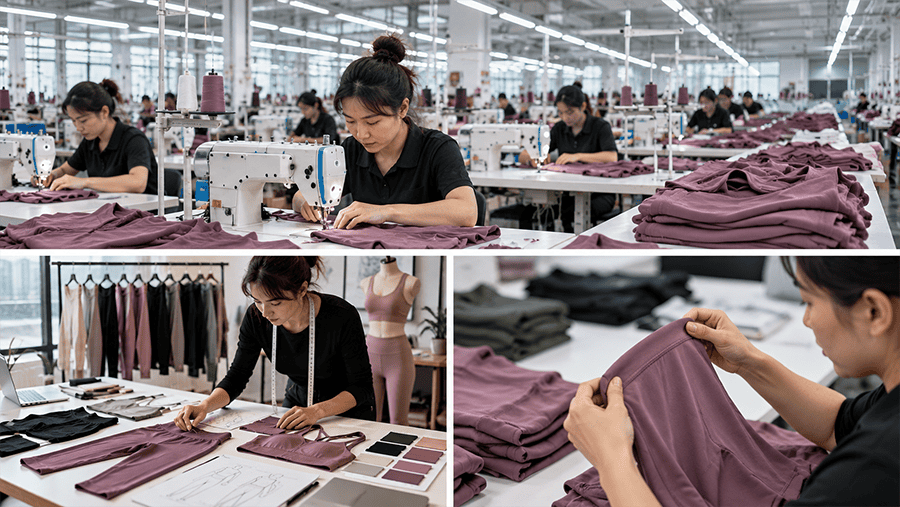
A clearly defined manufacturing workflow helps buyers organize approvals and reduce misunderstandings during production.
-
Define Your Collection
Choose the product categories, intended activity, customer profile, target price, colors, and size range.
-
Prepare Design Requirements
Provide tech packs, sketches, reference samples, garment images, measurements, or a written product brief.
-
Confirm Fabrics and Branding
Review material composition, weight, stretch requirements, colors, logos, labels, trims, and packaging.
-
Develop Samples
The manufacturer prepares or adjusts patterns, cuts and sews the samples, applies approved branding, and checks the resulting garments.
-
Review and Approve Samples
Inspect dimensions, fit, fabric, stitching, color, construction, and overall finishing.
-
Confirm Bulk Order Details
Finalize colors, quantities, size distribution, materials, labeling, packaging, and production instructions.
-
Begin Bulk Production and QC
Production follows the approved sample and confirmed specifications, with appropriate quality checks during and after manufacturing.
-
Arrange Shipping
Select the freight method and agreed trade terms according to shipment size, destination, delivery requirements, and budget.
For a complete development discussion, explore custom OEM activewear production .
How Much Does Private Label Activewear Manufacturing Cost?
There is no reliable universal unit price for private label leggings, sports bras, gym sets, or other activewear. Manufacturing costs vary according to design, materials, complexity, volume, and branding requirements.
Major Cost Factors
| Cost Factor | Why It Matters | How Buyers Can Manage It |
|---|---|---|
| Fabric | Composition, weight, performance, and availability affect cost. | Specify realistic fabric requirements. |
| Construction | Complex seams, lining, and details increase manufacturing work. | Simplify unnecessary design elements. |
| Order Quantity | Material purchasing and production setup influence unit economics. | Plan styles and size ratios carefully. |
| Custom Branding | Logos, labels, hangtags, and packaging add requirements. | Confirm branding methods early. |
| Sampling | Patterns, revisions, and materials require development resources. | Provide complete specifications. |
| Shipping | Destination, shipment volume, freight method, and terms affect landed cost. | Request separate freight quotations. |
A useful quotation should distinguish sample development, bulk garment cost, branding, packaging, freight, and any applicable import charges.
How Long Does Production Take?
At FreeFeel, standard sample development takes approximately 7–10 days after the required design, fabric, measurement, and customization details are confirmed.
Bulk production timing depends on the product category, fabric availability, order complexity, quantity, and production schedule.
Shipping time must be considered separately from manufacturing time. Express courier options may include DHL, FedEx, and UPS, while sea freight may be suitable for larger orders.
Build your launch schedule around confirmed milestones, not an assumed universal production timeline. Allow time for sample review, revisions, production, quality inspection, transportation, and customs processing.
7 Common Mistakes When Choosing an Activewear Manufacturer
1. Choosing the Cheapest Quote
A low unit price may exclude important services or use materials that do not meet your intended product requirements.
2. Ignoring Fabric Recovery
Stretch alone is not enough. Leggings and compression garments should recover their shape after movement.
3. Ordering Too Many Styles
A large first collection can create unnecessary inventory exposure. Consider launching fewer well-developed products before expanding.
4. Skipping Fit and Movement Testing
Evaluate garments during realistic movements rather than judging their appearance on a hanger.
5. Approving Incomplete Samples
Ensure all revisions and construction requirements are documented before authorizing bulk production.
6. Failing to Confirm MOQ Rules
A supplier may quote a minimum per style or per color rather than across an entire collection.
7. Overlooking Shipping and Import Costs
International buyers should request quotations under clearly defined trade terms and calculate the total expected landed cost.
Manufacturer Insights: What Matters During Activewear Development?
The following practical considerations reflect FreeFeel's documented product development and quality-control approach, rather than unverified customer case studies.
Leggings and Compression Shorts
Important development criteria include opacity, stretch recovery, waistband support, rise, seam construction, and freedom of movement.
Review custom activewear leggings and compression shorts when planning a performance collection.
Sports Bras
Fabric composition should be reviewed alongside the intended support level, strap construction, lining, underband stability, and fit.
Learn about custom sports bra development .
Gym Shorts and Running Shorts
Fabric weight, breathability, drying performance, waistband construction, pocket placement, and garment mobility can be more important than choosing the softest available fabric.
Custom Activewear Sets
Matching sets require attention to color consistency, complementary fabrics, fit relationships, and coordinated branding.
Explore custom gym sets and private label yoga sets for product development planning.
Start Your Private Label Activewear Collection
FreeFeel Gym Wear supports activewear brands with fabric sourcing, product development, sampling, OEM/ODM production, private label customization, and quality-control coordination.
Share your designs, target quantities, product specifications, branding needs, and preferred delivery destination to discuss a suitable manufacturing plan.
REQUEST A CUSTOM QUOTE →Frequently Asked Questions
What is a private label activewear manufacturer?
A private label activewear manufacturer produces sportswear and fitness apparel that another company sells under its own brand. Depending on the supplier, services can include logo application, custom labels, packaging, pattern adjustments, and original product development.
How much does it cost to start a private label activewear brand?
Startup costs depend on the number of designs, minimum quantities, fabrics, sampling, branding, packaging, freight, and inventory. Request an itemized supplier quotation before establishing a production budget.
What is the typical MOQ for private label activewear?
MOQ varies by factory and project. FreeFeel's standard MOQ is 100 pieces per color per style, with sizes normally mixed. Special fabrics, custom dyeing, trims, or packaging may require different quantities.
Can I customize leggings and sports bras?
Yes, where supported by the manufacturer. Customization can cover fabric, color, fit, dimensions, waistband construction, straps, lining, logos, labels, and packaging. Final options depend on the approved design and material availability.
Do I need a tech pack to order custom activewear?
A tech pack is helpful because it defines measurements, materials, construction, and finishing. FreeFeel can also review sketches, images, reference garments, and written requirements, although further specifications may be required before sampling.
How long does activewear sampling take?
Sample timing varies by supplier and project. FreeFeel's standard sample development timeline is approximately 7–10 days after the necessary specifications and materials have been confirmed.
Is China a good place to manufacture private label activewear?
China is a relevant sourcing location for many activewear brands, but supplier suitability depends on verified specialization, material availability, production consistency, order requirements, and total landed cost.
What quality checks should an activewear manufacturer perform?
Buyers should assess fabric inspection, production-stage checks, and finished garment inspection. Product-specific criteria can include garment measurements, stitching, stretch recovery, opacity, construction, labels, and packaging.
Can a startup launch a small activewear collection?
Yes, provided the proposed assortment meets the supplier's order requirements. A focused collection with fewer styles and colors can help reduce complexity and initial inventory exposure.
What is the difference between a factory and a trading company?
A factory directly manages manufacturing operations, while a trading company may coordinate production through third-party factories. Buyers should confirm who is responsible for sampling, production, quality control, and contractual obligations.
Final Thoughts
Finding the right private label activewear manufacturer requires balancing product expertise, customization flexibility, MOQ, sample quality, production consistency, communication, and total delivered cost.
FreeFeel Gym Wear and Ohsure Wear are two China-based sourcing options to investigate, while the other manufacturers in this list provide additional candidates for a broader supplier comparison.
Rather than choosing a manufacturer solely because of a ranking, request accurate quotations, examine physical samples, confirm factory capabilities, and agree on clear production requirements before placing your first bulk order.