FreeFeel Gym Wear / Apparel Sourcing and Product Development
Learn how OEM, ODM, and private label production differ in design control, development responsibilities, intellectual property, minimum orders, costs, sampling, and long-term brand strategy.
In activewear manufacturing, OEM generally means a factory produces garments to a brand's supplied or approved specifications, while ODM generally means the manufacturer develops a design that a brand selects or adapts. OEM typically offers more control over fit and construction; ODM may reduce initial development work. The terms vary by supplier, so confirm design ownership, exclusivity, minimum orders, costs, and sample approval in writing.
What Do OEM and ODM Mean in Activewear Manufacturing?
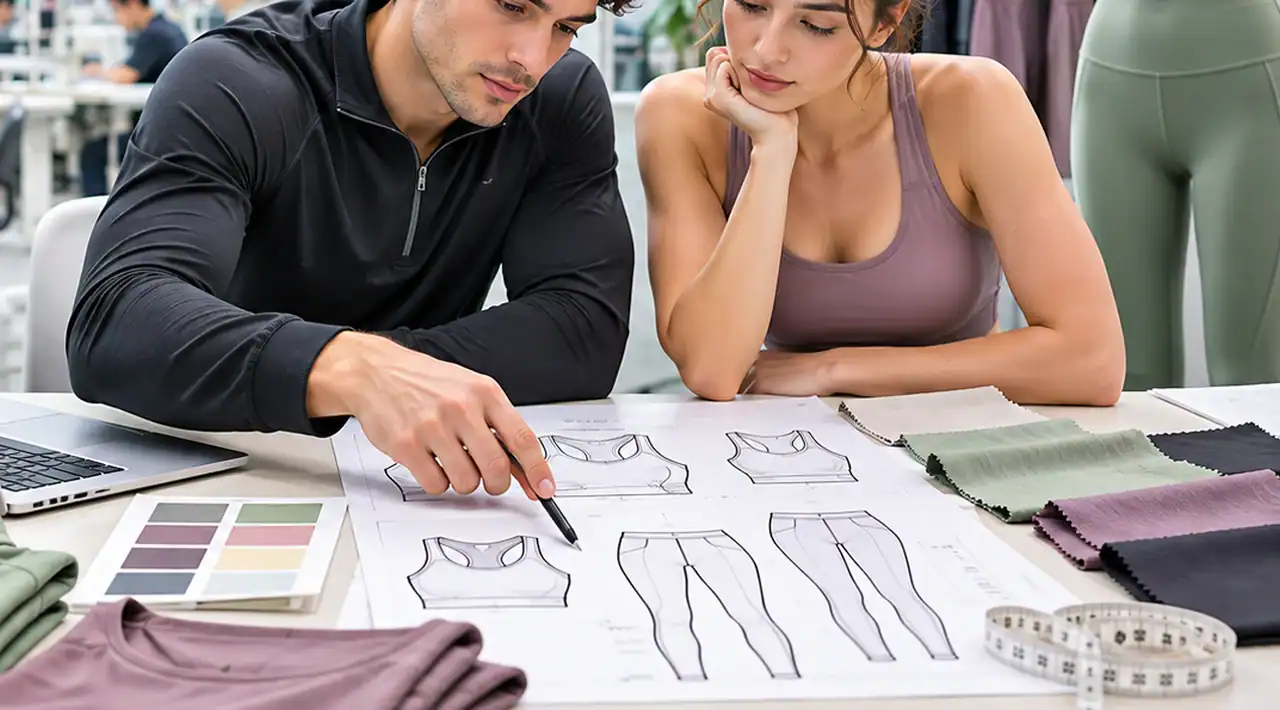
OEM (Original Equipment Manufacturer) usually describes a production arrangement in which a factory makes products according to a brand's designs, technical requirements, or approved specifications. In clothing, this can include cutting and sewing leggings from a buyer-provided tech pack, developing a pattern from the buyer's sketch, and applying the buyer's labels and packaging. The brand directs what the final garment must be, although a capable factory may advise on construction and materials.
ODM (Original Design Manufacturer) generally describes a manufacturer that creates or controls an existing product design and offers it to customers to select, customize, and manufacture. For activewear, this may mean a pre-developed leggings pattern or sports bra construction with configurable fabric colors, logos, trim options, and other approved changes. Some ODM suppliers develop completely new concepts for a customer, but those arrangements have their own design-ownership terms.
The labels are not standardized contracts. Some apparel suppliers call logo customization “OEM”; others use “ODM” for styles from a catalog, and still others describe the same program as private label. A term on a website cannot tell you who owns the sewing pattern, whether an identical garment can be sold to another brand, or how many revisions are included.
OEM vs ODM Activewear: The Main Differences
Use this table as an initial purchasing framework. The actual scope depends on the factory's proposal and your signed agreement, not merely the acronym.
| Buying factor | OEM activewear | ODM activewear | What to confirm |
|---|---|---|---|
| Design starting point | Brand's tech pack, sketches, samples or custom specifications | Supplier's existing or developed design platform | Source and rights to the base design |
| Pattern and fit control | Often greater brand control, subject to factory feasibility | Typically begins with an existing fit; modifications may be limited | Which measurements and panels can change |
| Development workload | May require substantial specification and sampling work | May shorten development if a suitable design is ready | Pattern fees and revision scope |
| Fabric and trims | Can be specified by the buyer, subject to mill minimums | May use prequalified options selected by the supplier | Fabric code, GSM, finishes and substitute rules |
| Unique brand identity | Potential for distinctive fit and construction | Potential for branding but base designs may be shared | Exclusivity, licensing and permitted resale |
| Sample schedule | Depends on custom development and feedback rounds | May be simpler with an approved base sample | Actual milestones, not a claimed shortcut |
| MOQ | Depends on garment, fabric, colors and factory | Also depends on materials, colors, style and factory | Minimum per style, color, size or fabric |
| Intellectual property | Brand ownership is possible but must be documented | Supplier may retain rights to the underlying design | Ownership of original and derivative work |
| Best potential fit | Brands requiring defined, unique product specifications | Brands seeking a faster starting point from suitable designs | Customer demand, budget and differentiation goals |
Do not assume: OEM automatically gives the buyer full IP ownership, ODM automatically means lower MOQ, or either model guarantees premium quality. Those outcomes require a specific contract, quotation and approved product.
OEM vs ODM vs Private Label vs White Label
These expressions overlap in the apparel industry, but they describe different aspects of production. OEM and ODM commonly signal a supplier's relationship to design and development. Private label emphasizes selling a product under the buyer's brand. White label often describes a relatively standardized item offered to multiple customers with limited branding changes.
| Model | Simple activewear example | Primary question |
|---|---|---|
| Custom OEM | A brand supplies an original high-waist leggings tech pack and approves a factory-made sample | Who owns the design files and pattern? |
| ODM | A supplier offers an existing sports bra block; a buyer selects approved fabrics and strap options | Can other brands purchase a similar base design? |
| Private label | A brand orders an available leggings style with its own inside label and retail packaging | What can be customized beyond logos? |
| White label | An existing gym T-shirt blank is supplied with minimal changes or basic branding | Is it a standard stock item with limited differentiation? |
A private-label program may be implemented through an ODM-style existing pattern. A brand-owned custom design may also carry a private label. In short, private label is not always an exclusive alternative to OEM or ODM. Ask the manufacturer to describe its actual development and ownership workflow rather than forcing a project into a rigid label.
Who Owns the Designs and Patterns in OEM and ODM?
For brand owners, intellectual property and design access may matter more than a small difference in factory price. A logo registered by the buyer is different from a supplier's preexisting base pattern. Paying for development also does not, by itself, settle ownership of CAD files, size grading, molds, artwork, or future production rights. Ownership and licensing depend on applicable law and written contractual terms.
Request written confirmation of rights to your own artwork, specifications, and paid development deliverables. Define how the factory may use your designs and what happens when you change suppliers.
Ask whether use is nonexclusive, exclusive in a defined market, licensed for a period, or transferred. Identify which improvements or custom modifications belong to whom.
A nondisclosure agreement can help protect confidential information, but does not replace an explicit ownership, licensing, tooling and exclusivity clause.
Confirm whether you receive editable patterns, grading, tech packs, material codes and approved sample records, and whether they can be used with another factory.
Contract Questions to Ask Before Paying a Deposit
The questions above are commercial drafting prompts, not legal advice. Have qualified counsel review IP, exclusivity, confidentiality and manufacturing agreements where appropriate.
Is OEM or ODM Activewear Cheaper?
ODM may reduce initial development expense when the supplier has a usable pattern, fabric and construction. Custom OEM may require more technical drawings, pattern work, and fitting rounds, but can be valuable when a brand needs a distinctive product. Neither model is automatically cheaper in total: factory price, sample revisions, logos, packaging, inspections, freight, and unsold inventory still matter.
Hypothetical Cost Comparison for 200 Leggings
The following is a purely illustrative cash-budget exercise. Both columns are invented scenarios—not supplier quotations, current market averages, or a guarantee that the finished designs are identical in quality or rights.
| Assumed cost item | Custom OEM scenario (USD) | ODM existing-design scenario (USD) |
|---|---|---|
| Factory production | 200 × $16.50 = $3,300 | 200 × $15.20 = $3,040 |
| Pattern / sampling / adaptation | $650 assumed | $200 assumed |
| Special branding and packaging | $180 assumed | $180 assumed |
| Independent quality inspection | $250 assumed | $250 assumed |
| Freight and destination charges | $600 assumed placeholder | $600 assumed placeholder |
| Total modeled initial cash outlay | $4,980 | $4,270 |
| Cash outlay allocated per garment | $24.90 | $21.35 |
All values are made-up teaching assumptions; no supplier or country price has been verified. This is a cash-outlay comparison, not a formal accounting unit-cost statement. Actual duties, tax treatment, testing, IP licensing, exclusivity, payment terms, returns and marketing can change the economics.
Additional Charges Buyers Often Miss
Request separate estimates for pattern grading, new sample rounds, fabric lab dips, custom dye lots, logo screens, embroidery setups, specialized bra cups, label/trim minimums, independent testing, tooling or license fees. Ask whether sample fees are refundable or credited, and what remains payable if the project stops before bulk production.
How Do MOQ and Production Lead Time Differ Between OEM and ODM?
MOQ (minimum order quantity) reflects the materials and production run a supplier will accept. ODM designs may use stock fabrics and existing patterns, which can reduce some setup work, but special colors or logos may still trigger a new minimum. OEM projects can have higher development requirements, yet a standardized material and simple construction may keep the garment MOQ manageable.
FreeFeel Gym Wear states a starting MOQ of 100 pieces per style/color, with sample lead times of 7–10 days and bulk production of 25–35 days, subject to project review. Those are company-provided reference figures, not guaranteed OEM-versus-ODM benchmarks. Fabric availability, sample revisions, production slots, inspection, and delivery may add time.
| Example collection under 100 pcs/style/color | Calculation | Minimum garments |
|---|---|---|
| One leggings style / one color | 1 × 1 × 100 | 100 |
| One sports bra design / three colors | 1 × 3 × 100 | 300 |
| Leggings and sports bra / two colors each | 2 × 2 × 100 | 400 individual garments |
These examples apply only when a supplier actually agrees to a per-style/color rule and accepts the specified size distribution. A matching set may contain two separate garment styles; mills can have additional material minimums.
For a realistic calendar, distinguish design approval, first sample, revisions, fabric allocation, cutting, sewing, QC, international shipping and customs. A faster initial ODM sample is not always the fastest finished-goods delivery if the chosen fabric is out of stock or a new size range needs grading.
When Should an Activewear Brand Choose OEM or ODM?
The right model depends on the maturity of your concept and the importance of product differentiation. Here are several practical cases.
An existing design with appropriate materials may lower the initial development burden. Evaluate ODM or private label if brand identity does not depend on unique fit or patented construction.
OEM may suit brands that have tested their customer fit needs and want detailed control over rise, waistband, gusset, compression and grading.
Custom OEM may be preferable if support, cup shaping, adjustable straps and target size range require extensive validation. An ODM base can still work if it passes testing.
ODM or private label may be suitable for supporting styles and seasonal colors, provided lead times, fit and IP limits are acceptable.
Example A: Signature Yoga Leggings
A label has its own tech pack, patented or distinctive panel concept, target body-measurement research and a tested fit block. It may prefer OEM with explicit rights to patterns, controlled fabric codes and approved production samples.
Example B: Launching a Gymwear Brand
A startup has demand for basic coordinated sets but no validated pattern. It may investigate an ODM or private-label design and limit first-order colors. It should still test the set for fit, opacity, and wash stability before ordering inventory.
How to Choose an OEM or ODM Activewear Manufacturer in 9 Steps
Decide what makes your product valuable
Identify your target customer and the reasons they should buy: a unique fit, proven fabric performance, a specific construction, attractive branding, or an accessible price. Decide which features require exclusive design control.
Deliverable: product strategy and non-negotiable requirements.
Prepare a technical brief or existing sample reference
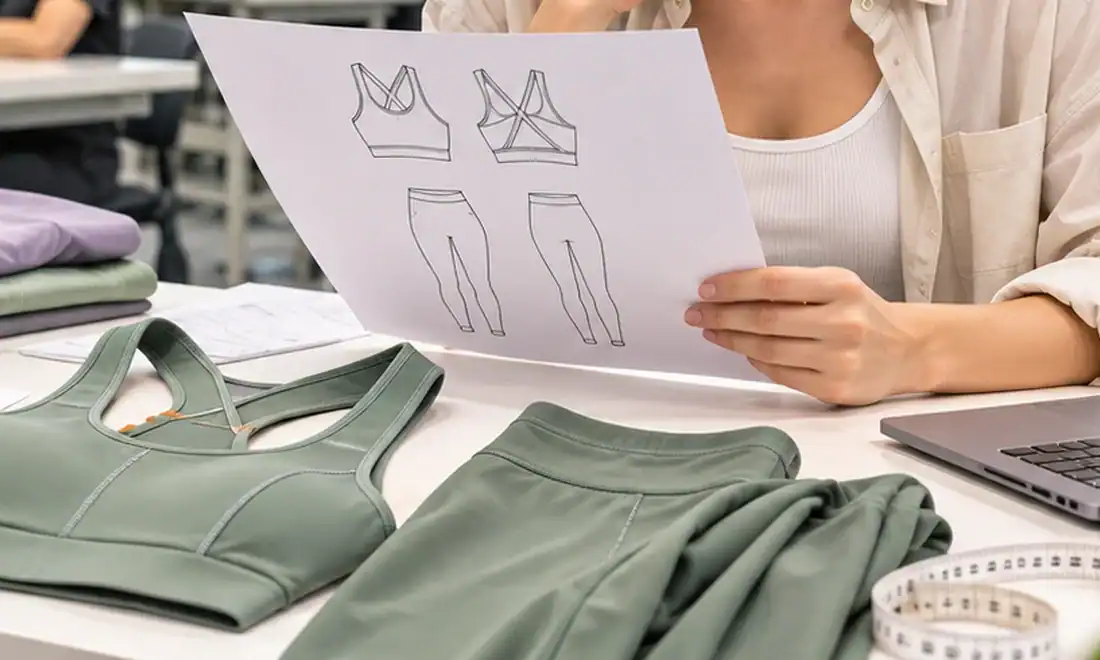
Include garment sketches, measurements, size range, intended activities, fiber and GSM targets, seams, logo, labels, order quantity and desired delivery. If requesting ODM, identify which catalogue features must be changed.
Deliverable: a common RFQ brief for all candidate factories.
Verify actual factory capabilities
Confirm the legal entity, manufacturing site, product specialization, in-house versus outsourced tasks and access to quality records. Ask for relevant examples of leggings, sports bras or training tops with comparable construction.
Deliverable: verified vendor and production arrangement.
Define the OEM or ODM design scope
Write down who supplies the pattern, who makes revisions, which options are selectable and whether the manufacturer already sells the base design. Request a marked-up list of deliverables, design fees and ownership terms.
Deliverable: agreed design-responsibility matrix.
Review fabric swatches and samples
Evaluate stretch recovery, squat opacity, fit, seam extension, pilling, wash behavior, bra-band comfort and other product-specific criteria. Use the physical finished garment rather than photographs or a catalogue description alone.
Deliverable: documented sample test and revision notes.
Compare itemized costs and MOQ rules
Ask for separate line items for samples, new patterns, stock-style adaptation, unit production, labels, testing, freight and any licensing or exclusivity fees. Confirm minimum units by style, color and size.
Deliverable: comparable project-cash and unit-cost model.
Document IP, confidentiality and tooling rights
Confirm rights to brand artwork and all bought development files, plus any restrictions on the supplier's base patterns and derivative designs. Have an appropriate legal professional review unusual exclusivity or ownership clauses.
Deliverable: signed ownership and permitted-use terms.
Lock the pre-production sample and QC rules
Agree on approved BOM, color standard, POM measurements, tolerance, logos, labels, packaging and relevant test methods. Record sample approval date and the version to use for bulk cutting.
Deliverable: controlled final tech pack and sample sign-off.
Start production and review repeatability
Monitor incoming fabric, in-line sewing quality, final inspection, carton contents and delivery. Assess sales, defects, fit feedback and material consistency before scaling the next order or expanding the design catalogue.
Deliverable: production scorecard and reorder decision.
OEM and ODM Still Need the Same Activewear Quality Standards
A ready-made ODM pattern does not eliminate the need for testing. Nor does a detailed OEM tech pack guarantee that bulk garments will be made correctly. Both models need verified fabric, garment fit, measurement tolerance, pre-production approval, and quality checks appropriate to the intended product and market.
| Quality item | What to check | Why it matters |
|---|---|---|
| Material identity | Approved fiber blend, GSM, construction, supplier code and lot | Prevents unexpected material substitutions |
| Leggings performance | Stretch opacity, recovery, waist fit and seam durability | Controls movement and coverage complaints |
| Sports bra performance | Band and cup fit, strap stability, support in intended movement | Checks comfort and product claims |
| Garment measurements | POM chart, grading, sample comparison, allowed tolerances | Supports repeatable sizing |
| Care performance | Relevant shrinkage, pilling, colorfastness and logo durability | Protects quality after laundering |
| Commercial compliance | Fiber/care labels, artwork, packing quantities and origin details | Prevents incorrect delivery and claims |
For either model, insist on a written change-control process. If the factory proposes switching the fabric or seam technique after approval, the buyer should review the consequences for fit, function, cost and lead time before authorizing the change.
Common OEM vs ODM Mistakes and a Manufacturer's Perspective
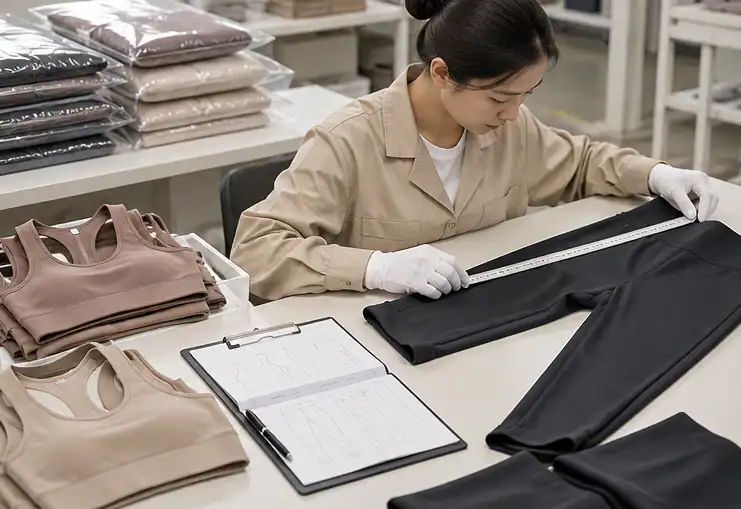
From a manufacturer's planning perspective, ambiguous design responsibility creates avoidable delays. A brand may assume that the factory will create its measurements from an inspiration photo, while the factory may assume a complete tech pack is already approved. In ODM programs, the parties may disagree about how many changes to an existing style can be made without redesigning the pattern. These questions should be resolved before deposits and cutting.
FreeFeel Gym Wear describes itself as a China-based OEM and private-label activewear manufacturing partner. Its company-provided reference information includes 15+ years of experience, a 3,000 m² facility, 100+ workers, MOQ from 100 pieces per style/color, samples in about 7–10 days, and bulk production in about 25–35 days. These are supplier statements requiring verification for the actual garment, fabric and schedule. They do not independently confirm a specific ODM catalogue or legal design-transfer service.
Manufacturers use OEM, ODM and private label differently; document actual services and rights.
A sample payment does not necessarily transfer the factory's existing patterns or files.
A branded garment may still use a base pattern available to competitors without agreed exclusivity.
Price differences may come from material weight or construction, not the OEM/ODM model.
Additional colorways can multiply total garments even with one design.
Factory catalogues and technical drawings alone cannot prove fit or bulk consistency.
Final OEM / ODM Evaluation Checklist
FAQ: OEM vs ODM Activewear Manufacturing
What is the main difference between OEM and ODM activewear manufacturing?
OEM usually starts from the brand's specified or approved design, while ODM commonly starts from a manufacturer-developed design that buyers can select or customize. Actual responsibilities vary by supplier and must be defined in the agreement.
Does OEM mean the factory only sews my tech pack?
Not necessarily. OEM factories may assist with patterns, fabric sourcing and technical improvement. Clarify who makes design decisions, prepares graded measurements, approves changes and owns the resulting files.
Is ODM the same as private label?
Not exactly. ODM describes the manufacturer's role in developing or providing the design; private label describes selling garments under a buyer's brand. An ODM-style product can be offered as private label, but the expressions are not interchangeable in every contract.
Is OEM or ODM cheaper for a new activewear brand?
ODM may reduce initial pattern-development work when a suitable design is available, but it is not universally cheaper. Consider garment price, modifications, sample fees, rights, inspection, shipping and inventory risk. The numerical examples in this guide are hypothetical.
Does ODM activewear have a lower MOQ?
Not automatically. An existing pattern or stocked fabric may make a small order easier, but garment, fabric, label and dye-lot minimums still apply. Ask for the MOQ per style/color and any independent material minimums.
Who owns an ODM sports bra or leggings pattern?
The supplier may own the preexisting design, while the brand may own its logo or separately developed work. The outcome depends on documented rights, applicable law and contract terms. Paying for a sample does not guarantee full ownership.
Can I make an ODM design exclusive to my brand?
Possibly, if the supplier has the right and agrees in writing. Define the exact design, markets, term, product categories, modifications, fees and remedies. Do not assume private-label branding creates exclusivity.
Which model is better for a startup gym clothing brand?
If the brand is testing demand and has no tested original pattern, a suitable ODM or private-label design may simplify development. If its value depends on unique fit or construction, OEM may be more appropriate. Test both against the target customer and budget.
Do I need a tech pack for ODM activewear?
At minimum, record the approved style, fabric, sizes, colors, logo, labels, packaging and quality requirements. If you customize the base product, document all changes and approve a new pre-production sample. A full custom tech pack may not always be needed, but a controlled specification is.
How long do OEM and ODM sportswear orders take?
ODM sampling may be faster if a suitable sample and fabric already exist; custom OEM can require additional development rounds. FreeFeel's stated planning figures are 7–10 days for samples and 25–35 days for bulk production, subject to individual project confirmation; these are not universal model-specific schedules.
Send your sketches or tech pack, target fabric and fit, styles, colors, size breakdown, branding requirements and expected quantities. Ask for a project-specific assessment of product development, sample approvals, MOQ, total cost and production responsibilities.
Explore FreeFeel Gym WearEditorial disclosure: OEM, ODM and private-label terminology varies by supplier. Intellectual property terms require a written agreement and appropriate legal review. Every dollar value is a hypothetical educational example, not a real-time factory quotation. FreeFeel's MOQ, facility and lead-time figures are company-provided references that require project-specific confirmation. All article visuals are reused AI-generated illustrations, not actual factory photographs. Ohsure links have not been live-checked.