FreeFeel Gym Wear / Low MOQ Activewear Sourcing Guide
A practical sourcing roadmap for startup clothing brands seeking small-batch leggings, sports bras, workout tops, and private label collections without overlooking fabric minimums, quality, or inventory risk.
To find low MOQ activewear manufacturers, search for factories experienced in small-batch sportswear and compare their minimums by style, color, fabric, and size. Start with a focused product brief, ask whether existing patterns and stocked fabrics are available, and request itemized quotes. Verify the production site, test physical samples, and calculate total landed costs before committing to a first order.
What Is a Low MOQ Activewear Manufacturer?
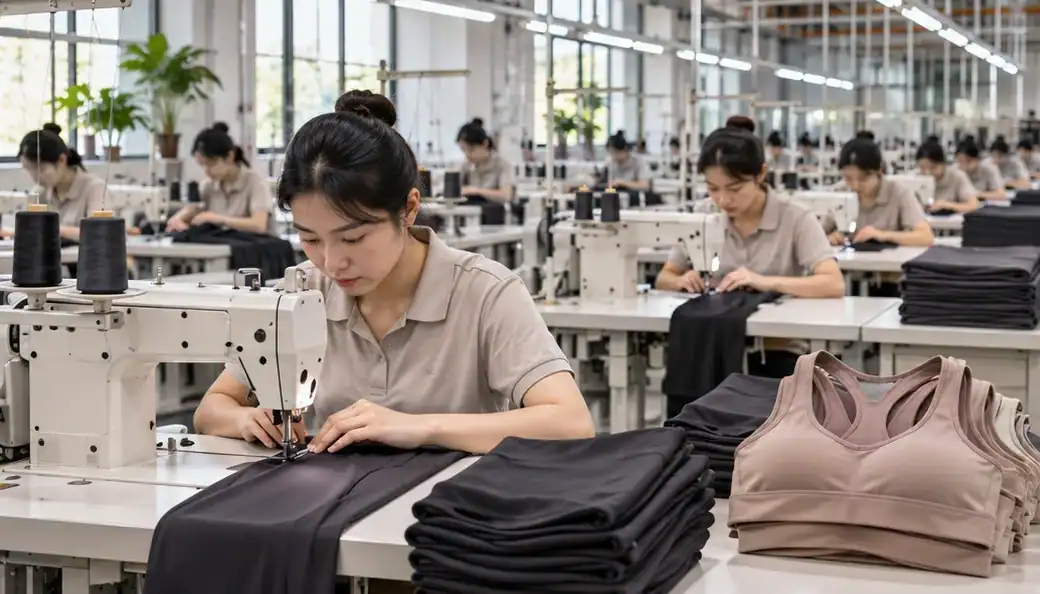
MOQ means minimum order quantity: the smallest order a supplier agrees to produce under defined material, design, and commercial conditions. A low MOQ activewear manufacturer can accept relatively small garment runs compared with other options a buyer is considering. There is no single universally accepted number that qualifies as "low MOQ" across all activewear products, regions, or factories.
A factory may quote a minimum for each style and color, while its fabric mill imposes a separate minimum for knitting or dyeing. Custom elastic, bra cups, labels, or packaging may also have their own minimum purchase quantities. The label "low MOQ" is therefore useful only after the supplier explains the exact counting rule and what is included.
Small-batch manufacturing is particularly relevant to founders who need to validate a new leggings fit, launch a limited yoga set, or avoid carrying many untested sizes and colors. But low MOQ is not equivalent to low total cost: setup, sampling, freight, inspection, and other fixed expenses may be allocated across fewer pieces.
Where to Find Low MOQ Activewear Manufacturers
Rather than collecting hundreds of generic supplier names, build a shortlist from several complementary channels. Use the same product brief to check whether each candidate genuinely makes your category of performance apparel and accepts your intended order.
Try queries such as "low MOQ leggings manufacturer", "small batch sports bra factory", "private label activewear 100 pcs per color", or "custom gymwear OEM small order". Check whether results describe production, not only resale.
Supplier directories and marketplaces can help assemble a shortlist. Verify the legal entity, actual production site, sample quality, and platform claims independently; marketplace labels alone are not an audit.
Relevant apparel, textile, and sourcing exhibitions can provide product samples and technical contacts. Confirm whether an exhibitor is the manufacturer, a sourcing office, or a trading company.
Pattern makers, technical designers, independent inspectors, and experienced founders may know suppliers suited to your product. Check each referral against your own requirements.
Search Phrases That Signal Better Product Fit
Look for specific product evidence rather than phrases like "best quality clothing". A useful leggings listing should discuss stretch fabrics, fit development, gussets, waistband construction, and opacity; a sports bra listing should address band, strap, lining, and cup construction. Ask for anonymized recent samples relevant to your style.
Build an initial list of five to eight plausible companies, then shortlist two or three for physical sampling. The numbers are a suggested buyer workflow, not a claim about industry conversion rates or the number of factories required.
Which Production Model Works Best for Small Orders?
A small starting quantity is sometimes easier when a buyer uses an existing, validated product design or in-stock fabric. However, the cheapest entry model may not give you enough control over technical leggings or a supportive sports bra.
| Manufacturing model | Possible small-order advantage | Limits to investigate |
|---|---|---|
| Stock blanks / white label | Existing finished inventory can avoid a new cutting run | Limited fit, fabric, originality, and stock continuity |
| Print-on-demand | Can handle single-unit graphic basics with eligible blanks | Usually limited technical customization for performance bras and leggings |
| Private label / existing ODM design | Existing patterns and selected stocked fabrics may reduce setup | Garment/color MOQs still apply; design ownership may be restricted |
| Custom OEM | Potential for unique fit, fabric, and construction | Sample development, pattern grading, and specialized materials may raise minimums |
Private label and ODM often overlap: a manufacturer-designed garment can be sold under a customer's label. OEM can also be sold under a private label. Ask about actual development responsibilities and rights, not just a service label.
For a first yoga leggings launch, a supplier's proven existing pattern may be a useful starting point if it passes your fit and performance tests. For a truly distinctive construction, custom OEM can be warranted once the brand has budgeted for technical development.
How to Calculate MOQ by Style, Color, Size, and Material
Suppose a supplier states a starting MOQ of 100 pieces per style/color. Under that exact rule, every distinct garment style in every color must reach its own minimum. Mixing sizes may be possible, but only with an approved size ratio. A separate fabric minimum may override the garment-level calculation.
| Collection plan | Calculation | Minimum units |
|---|---|---|
| One pair of leggings, one color | 1 × 1 × 100 | 100 garments |
| One pair of leggings, three colors | 1 × 3 × 100 | 300 garments |
| Leggings and sports bra, one color each | 2 × 1 × 100 | 200 garments |
| Leggings and sports bra, two colors each | 2 × 2 × 100 | 400 garments |
| Leggings in two colors plus a single-color top | 2 × 100 + 1 × 100 | 300 garments |
These examples describe one hypothetical MOQ counting rule. They do not imply that all factories or fabric mills use the same minimum.
Can You Mix Sizes to Reach 100 Pieces?
A possible allocation for one style in one color is XS 10, S 20, M 35, L 25, XL 10—100 pieces altogether. This is a numerical example, not a recommended sales size ratio. The manufacturer must confirm whether sizes can be combined and whether extended sizes or different inseam lengths count as distinct patterns.
Which Minimums Are Easy to Miss?
Fabric mills may impose minimum dye lots for custom colors. Transfer-print suppliers may require setup charges, while woven label or packaging providers may require more labels than finished garments. Ask whether unused material and trims will be stored for reorders, billed separately, or purchased by the factory.
How to Verify That a Low MOQ Supplier Is a Reliable Manufacturer
A supplier's willingness to accept 100 pieces is not proof of production expertise. Some vendors coordinate subcontractors; others specialize in simple lifestyle garments rather than engineered stretch sportswear. Neither model is inherently unacceptable, but responsibilities must be transparent.
| Verification area | Evidence to request | Red flag |
|---|---|---|
| Business identity | Registered company name, contract entity, business address, payment beneficiary | Names or bank details that cannot be reconciled |
| Production location | Current facility address, product-specific walkthrough, outsourced steps | Refusal to explain who will make the order |
| Category expertise | Relevant stretchwear samples, sewing methods, fabric knowledge | Only generic fashion photos and no technical explanation |
| Material control | Fabric codes, composition, GSM, approval and lot tracking | Unapproved substitutes or vague "premium" material claims |
| Sample process | Sample cost, revisions, measurements and written approval | Bulk payment requested before a meaningful sample review |
| Quality system | Incoming checks, inline/final QC, defect handling and independent inspection rights | No objective quality acceptance rules |
| Commercial terms | MOQ breakdown, Incoterm, schedule, deposit and defect remedies | Changing terms or unrealistic blanket guarantees |
A live video walkthrough, product-specific sample, third-party inspection, or factory audit can provide additional evidence, but no single step is sufficient on its own. For an expensive order, independent verification may be appropriate.
What to Send a Low MOQ Activewear Factory for an Accurate Quote
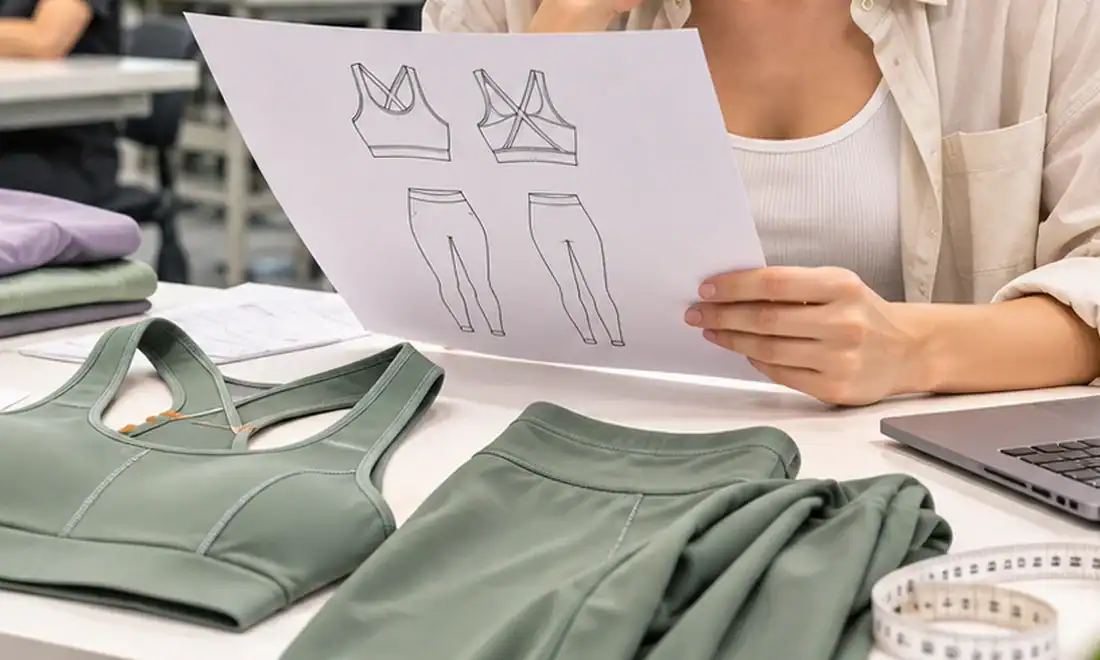
Factories can evaluate small orders more accurately when they receive a concise, complete request. Even if you do not have a formal tech pack yet, specify the intended product and identify which choices are still open to supplier advice.
Subject: Small-Batch Custom Activewear RFQ – Leggings, 100–300 Pieces
Hello, we are developing a private-label activewear collection. Our first product is a high-waisted training legging. Please confirm whether you can support a trial order and provide the following details:
1. MOQ per style, color, fabric, and size; 2. available fabric options, composition, GSM, and swatches; 3. sample cost, revision scope, and lead time; 4. unit quotes for 100, 200, and 300 pieces of the same approved style/color; 5. logo, labels, packaging, and testing charges; 6. bulk lead time, QC process, Incoterm, and shipping assumptions; 7. company legal name, production location, and in-house versus outsourced steps.
We can share a technical brief and preferred size breakdown for your review. Please specify what is included in each quote and whether an existing factory pattern or stocked fabric can reduce setup complexity. Thank you.
Request the same technical specification from every shortlisted supplier. A cheaper quote for thinner fabric or a different waistband is not a fair comparison. If a factory proposes a simplification, ask it to describe the change and issue a separate quote.
Does Low MOQ Mean Low Manufacturing Cost?
Not necessarily. Smaller production runs can spread pattern, setup, cutting, and handling expenses over fewer units. Buying more can sometimes reduce the factory unit price, but it also ties up more cash in stock. Sample costs, freight, and compliance requirements are often incurred regardless of small order size.
Hypothetical Order-Volume Comparison
| Leggings quantity, one color | Assumed unit quote | Factory subtotal | Inventory implication |
|---|---|---|---|
| 100 pieces | $16.00 | $1,600 | Smaller first inventory commitment |
| 200 pieces | $14.50 | $2,900 | More total cash required |
| 300 pieces | $13.80 | $4,140 | Lower assumed unit cost, highest stock exposure |
All prices above are invented solely for illustration. These are not current quotes, industry averages, or FreeFeel prices; quantity discounts are not guaranteed.
Example: Cash Budget for 100 Pairs of Leggings
Assume 100 pairs at the hypothetical $16.00 factory price. The following numbers show why a low production MOQ should be evaluated alongside other costs.
| Expense | Hypothetical USD | Budget note |
|---|---|---|
| Garment production | $1,600 | 100 × $16.00 assumed unit quote |
| Sample development | $240 | One-time allowance |
| Additional labels and packaging | $90 | Assumed extra charge |
| Independent inspection | $180 | Illustrative allowance |
| Freight and receiving | $350 | Placeholder, not a logistics quote |
| Import charges and fees | $250 | Placeholder, not a customs or tax estimate |
| Total modeled initial cash outlay | $2,710 | Includes one-time sampling |
| Cash outlay allocated per garment | $27.10 | $2,710 ÷ 100, not formal inventory accounting cost |
This is a teaching model. It excludes marketing, retailer commissions, fulfillment, returns, and overhead. Actual duties, recoverable taxes, inspection and sample accounting treatment depend on jurisdiction and agreements. Verify all current cost categories for the final destination.
Budget principle: Optimize for the smallest viable, testable, and financially sustainable order, not the lowest MOQ advertised on a search result. Keep a reserve for sample revisions and unexpected shipping or quality issues.
How to Find and Work With a Low MOQ Activewear Manufacturer in 9 Steps
Choose a single hero garment
Start with the customer need and one defined product: leggings, sports bra, training shorts, or T-shirt. Limit unnecessary colorways and specify the technical features that cannot be compromised.
Output: focused product and customer brief.
Prepare sketches and minimum specifications
Define fabric, fit, seams, size range, color and quantity. Record which features are flexible and whether a supplier's existing pattern could be appropriate.
Output: lightweight RFQ or preliminary tech pack.
Build a multi-channel factory shortlist
Search product-specific terms, supplier directories, sourcing events, and professional referrals. Avoid copying unverified “top manufacturer” lists as though they were factory audits.
Output: initial supplier research sheet.
Confirm factory status and actual MOQ
Ask who makes the product, whether work is subcontracted, what counts as a separate style/color, and which fabric and trim minimums apply. Request written confirmation.
Output: verifiable supplier profile and quantity matrix.
Request comparable itemized quotations
Use the same fabric, construction and quantities with all candidates. Separate sampling, bulk production, artwork, packaging, quality testing, freight and trade charges.
Output: like-for-like RFQ scorecard.
Order samples and test real performance
For leggings, check squat opacity, stretch and recovery, seams and movement fit. For sports bras, check band stability, support and strap comfort. Compare results after laundering.
Output: approved sample with revision notes.
Validate quality and order protections
Confirm the legal counterparty, sample approval, fabric codes, measurements, acceptable defects, independent inspection access, deposit terms and remedies for nonconforming goods.
Output: approved tech pack, contract and QC plan.
Run the first production lot with checkpoints
Check incoming materials, inline production, final measurements and packaging. Do not let an urgent shipping date override the approved sample or essential quality tests.
Output: traceable first-batch inspection and delivery record.
Review sell-through before expanding
Track actual sales by size/color, refunds, fit complaints, landed cost and supplier responsiveness. Use the data to decide whether to reorder, change the pattern or add colors.
Output: evidence-based second-order plan.
A Manufacturer's Perspective: How to Make a Small Order Work
From a production-planning perspective, reducing the number of fabric codes, colorways and new patterns can make a small activewear order more practical. Reusing a proven pattern can reduce development work, but only if the garment meets the brand's target fit and performance. A lower MOQ should never justify skipping measurements, approved materials or fit tests.
FreeFeel Gym Wear describes itself as a China-based OEM and private label activewear manufacturer. Its company-provided planning references include a starting MOQ of 100 pieces per style/color, 7–10 days for samples, and 25–35 days for bulk production, subject to individual project confirmation. The company also states 15+ years of experience, a 3,000 m² facility and 100+ workers. These claims are not independently audited in this guide and are not a guarantee that every custom material or construction qualifies for the minimum.
For a new brand, a useful question is: “Can you suggest the simplest existing pattern and stocked fabric that meet these exact performance requirements, and show the trade-offs in the quotation?” That invites genuine production planning rather than an unverified promise to waive all minimums.
Common Low MOQ Sourcing Mistakes—and the Final Checklist
A quoted 100-piece minimum may apply independently to each color and style, not the entire collection.
A custom dye lot or specialty knit may require more material than the garment order uses.
Freight, sample fees, inspections, and high return rates can erase an apparent manufacturing saving.
Lower GSM, fewer seams, or a different waistband may explain an attractive quote.
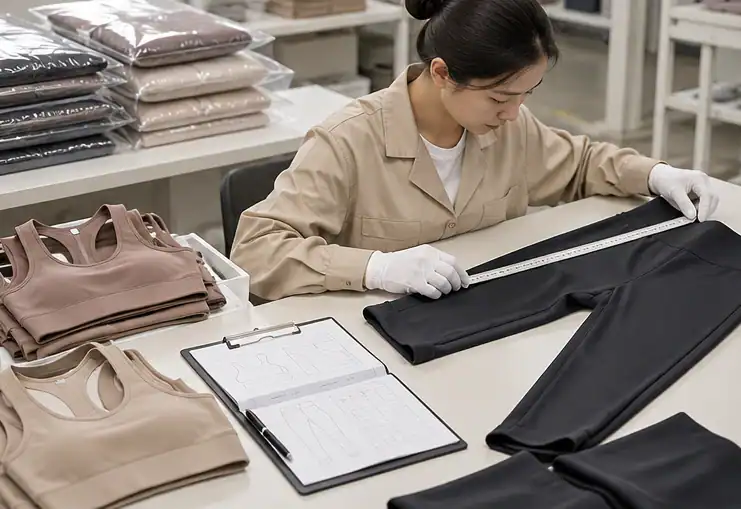
Fabric recovery, squat opacity, bra support, fit, and washing behavior need appropriate physical evaluation.
Verify who actually cuts and sews the garments, and who is liable for defects and delivery.
Low MOQ Manufacturer RFQ Checklist
FAQ: Finding Low MOQ Activewear Manufacturers
What is considered a low MOQ for activewear manufacturing?
There is no universal threshold. A quantity is low relative to the garment, fabric, level of customization and available manufacturers. Ask whether a stated number applies to each style, color, fabric or the whole order, and compare the total quantity and landed cost you actually need.
Can I order 50 pieces of custom leggings?
Some stock-based or specialized small-run arrangements may accept 50 pieces, but custom OEM construction and fabric requirements can make that impractical. The factory must confirm its actual minimum and any surcharge. FreeFeel's stated starting MOQ is 100 pieces per style/color, not 50.
Does a 100-piece MOQ include all colors?
Not when the rule is 100 pieces per style/color. One style in black and olive may require 200 garments. Obtain a written style/color and size breakdown before calculating your investment.
Can different sizes be mixed in one low MOQ order?
Sometimes. A supplier may allow XS–XL to share the same style/color minimum, but size-ratio rules, extended-size patterns and minimums per size vary. Ask the factory to approve your exact allocation.
Is private label better than OEM for a small order?
Private label based on an existing suitable pattern may involve less development work, especially with stocked materials. Custom OEM provides more control over unique fit and construction but may require additional sampling. Choose based on technical requirements and a complete quotation.
Where can I find low MOQ gymwear manufacturers in China?
Use targeted product searches, relevant supplier directories, trade events and referrals. Verify the legal company, production site, current MOQ, activewear-specific samples and QC plan. Avoid trusting an unverified ranking or supplier badge as proof of manufacturing capability.
Will a lower MOQ increase the price per piece?
It may because fixed setup and development costs are divided among fewer units. Discounts are not automatic and depend on the fabric and production program. Evaluate the entire inventory cash requirement, expected sell-through and landed cost.
Are sample fees refundable for a first activewear order?
Terms vary. Some factories may credit eligible development fees toward bulk orders, while others charge separately. Confirm pattern charges, revision limits, refund or credit conditions and file ownership in writing.
How long does a low MOQ order take?
Timing depends on fabric readiness, sample revisions, capacity, inspection and shipping. FreeFeel reports project-dependent sample times of 7–10 days and bulk production of 25–35 days, excluding some additional stages. A smaller order is not automatically faster.
How can I check whether a small-batch factory is reliable?
Verify the contracting entity and production location, request product-specific samples and material codes, evaluate fit and durability, define QC criteria, and obtain an itemized contract. An independent inspection or audit can help for larger or higher-risk orders.
Send your sketches or tech pack, fabric preferences, size/color breakdown, expected quantities and delivery destination. Ask for a project-specific assessment of MOQ, sampling, product quality and production terms.
Explore FreeFeel Gym WearEditorial note: Low MOQ is not an industry-standard fixed number. All dollar amounts in this article are hypothetical arithmetic, not real-time quotes or market-average prices. FreeFeel capacity, MOQ and lead times are company-provided references subject to confirmation. Images are reused AI-generated illustrations, not actual supplier photographs or factory audit evidence. External Ohsure URLs and applicable trade costs have not been live-verified.