FreeFeel Gym Wear / Global Activewear Sourcing Comparison
A practical B2B comparison of manufacturing costs, minimum orders, sampling, production control, lead times, shipping, compliance, and long-term supply-chain strategy for fitness apparel brands.
Neither China nor the USA is automatically the better place to manufacture activewear. China may offer broader sourcing options and competitive factory pricing for certain products, while US production can improve proximity, communication overlap, and domestic replenishment for US-based brands. Compare identical garment specifications, verified factory capabilities, minimum orders, total landed costs, quality controls, and realistic delivery dates before choosing a manufacturing partner.
What Does China vs USA Activewear Manufacturing Really Mean?
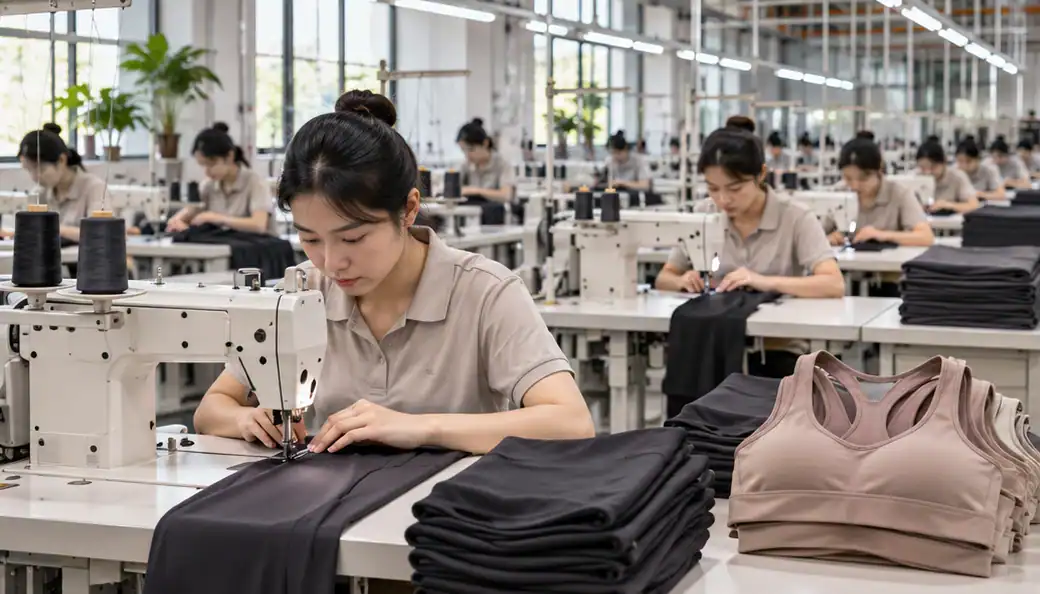
When a brand compares activewear manufacturers in China vs the USA, the practical question is not which country is universally better. It is which specific supplier and supply-chain arrangement can deliver the intended garment, quality, price, and replenishment schedule. A company with a US sales office might manufacture overseas. A US sewing workshop may use fabric and trims sourced from outside the country. A China-based supplier may operate its own factory or coordinate subcontractors. Verify where each production step happens.
For leggings, sports bras, gym shorts, and performance tops, product engineering often matters as much as geography. Stretch recovery, squat opacity, grading, seam quality, logo durability, and wash performance can vary significantly between two factories in the same country. Evaluate suppliers against an approved tech pack, sample, and quality plan.
China vs USA Activewear Manufacturers: Side-by-Side Comparison
The table describes possible operating advantages and trade-offs, not guarantees for every supplier. Many factors depend on the buyer's location, order volume, product complexity, and actual factory capabilities.
| Factor | Manufacturing in China | Manufacturing in the USA | What to verify |
|---|---|---|---|
| Factory unit pricing | May be competitive for many cut-and-sew programs; varies with fabric and complexity | May have higher labor-related costs; actual prices vary widely | Same tech pack, quantity and delivery terms |
| MOQ | Often set by style/color and material availability | Some shops offer short runs; other factories require substantial minimums | Written per-style, color, and size rules |
| Fabric and trims | Access to certain regional textile and trim supply clusters may simplify sourcing | Local sourcing may be available; imported fabrics and components are also common | Actual mills, lead times and substitute approval |
| Sampling collaboration | Remote fitting and shipment may need structured reviews | In-person development may be easier for a US-based team | Sample process and revision responsibilities |
| Bulk lead time | Depends on fabric readiness, capacity, and number of revisions | Depends on capacity, supplies, and development readiness | Factory-ready date, not only quoted sewing days |
| Freight and customs | US importers must plan international transport and applicable customs obligations | US-made finished goods delivered domestically generally avoid importing those finished goods | Destination, origin, Incoterm, freight, duties and taxes |
| Communication | Time-zone and language differences may require better documentation | Same-country contact can simplify scheduling for US buyers | Actual account team and response quality |
| Quality control | Strong outcomes are possible with verified factory and inspection systems | Strong outcomes are possible with verified factory and inspection systems | Sample tests, in-line QC and final inspections |
| Origin marketing | Origin must be determined and disclosed under applicable rules | Domestic-sounding supplier name does not establish a valid “Made in USA” claim | Substantiated manufacturing origin and labeling requirements |
For a US-based startup, USA manufacturing may make in-person coordination and local replenishment easier. For a brand with well-developed technical specifications and longer planning horizons, a suitable Chinese OEM factory may be attractive. Neither outcome can be assumed until suppliers quote and sample the same product.
Is Activewear Cheaper to Manufacture in China or the USA?
Factory unit prices can differ between countries, but the landed cost of a saleable garment is the more relevant number. For an imported garment, this may include production, applicable freight, insurance, customs charges, nonrecoverable duties or taxes, brokerage, and receiving-related costs. A total project cash budget may additionally include samples, inspections, development, contingency, and marketing. These are related but not identical measures.
Worked Example: 200 Pairs of Custom Leggings
To illustrate the calculation, consider two hypothetical, unverified quotes for the same approved 200-pair leggings specification delivered to a US business. The assumed prices below are invented solely for budgeting education; they are not real China or USA factory quotes, tariff estimates, or countrywide averages.
| Cost component | China option (illustrative USD) | USA option (illustrative USD) |
|---|---|---|
| 200 finished leggings at hypothetical unit price | 200 × $13.50 = $2,700 | 200 × $24.00 = $4,800 |
| Freight / delivery allowance | $750 | $240 |
| Finished-garment customs and import-cost placeholder | $400 | $0 in this assumed domestic-finished-goods scenario |
| Quality-inspection allowance | $250 | $200 |
| Illustrative acquisition-related subtotal | $4,100 | $5,240 |
| Sample / development allowance | $350 | $400 |
| Total modeled project cash outlay | $4,450 | $5,640 |
| Modeled outlay per pair | $22.25 | $28.20 |
Every figure above is a hypothetical assumption, not observed pricing or an actual duty amount. The USA column assumes the finished garments qualify as domestically produced and delivered to a US buyer; imported inputs can still create upstream costs. Tax, insurance, brokerage, finance charges, returns and other expenses can differ. Accounting treatment of inspections, samples and taxes is situation-dependent.
In this illustration, the China option has a lower total cash outlay, but that finding is true only under the invented assumptions. If expedited air freight, additional customs charges, lower US minimums, fewer domestic returns, or faster replenishment change the numbers, the comparison may narrow or reverse. Build a current landed-cost worksheet for your exact destination and order.
Cost Per Piece Is Not Total Brand Profit
After receiving the products, brands still pay for warehousing, e-commerce fees, fulfillment, promotion, returns, and customer support. A cheap factory quote that causes high defect rates or excessive slow-moving inventory can erode margin. Ask what proportion of the cost is avoidable, one-time, recurring, or dependent on order size.
MOQ Comparison: Is China or the USA Better for Small Orders?
Minimum order quantity (MOQ) varies by factory rather than following one fixed countrywide rule. Some US workshops may accommodate development runs or shorter batches, while others need larger commitments to cover setup and material purchasing. Chinese OEM suppliers also vary: a factory can offer smaller customized runs for some fabrics and higher minimums for custom-dyed or technically complex products.
FreeFeel Gym Wear states a starting MOQ of 100 pieces per style/color for its projects, subject to confirmation. That means one leggings style in three colors could require 300 individual pairs under the stated rule. It does not mean every Chinese manufacturer offers the same minimum or that a US maker necessarily offers less.
| Order request | Questions for either country | Inventory consideration |
|---|---|---|
| One style, one color | What is the garment MOQ and size split? | May minimize SKU complexity |
| One style, three colors | Is each color a separate minimum? Is fabric stocked? | May multiply total units before sales are proven |
| Leggings plus sports bra set | Are the bra and leggings counted as separate styles? | Two technical fits and potentially separate minimums |
| New custom fabric | Does the mill have a higher knitting or dye-lot minimum? | Possible additional material commitment |
| Small repeat orders | Can the supplier reserve material and keep approved patterns? | Could improve replenishment predictability |
Startup strategy: Compare the smallest viable order and the estimated sell-through of each size and color. A higher unit price can sometimes be acceptable if it materially reduces unsold inventory, but that must be calculated from your own expected demand.
Sampling, Production Lead Times, Shipping and Time Zones
A quote that says “30-day production” usually does not tell the whole story. A launch calendar should separate product development, first sample, fit revision, pre-production approval, fabric sourcing, cutting and sewing, QC, transport, import clearance, and warehouse receiving. Always define whether the supplier quotes working or calendar days and when the production clock starts.
A US-based brand may find local visits easier when working with a US factory. Remote China sampling can still work with precise feedback and shipped physical samples.
Actual turnaround depends on the mill, inventory, pattern readiness, capacity and approval status—not nationality alone.
Domestic delivery can simplify US distribution; imports require international transport planning and the relevant customs process.
For context, FreeFeel's company-provided reference terms state samples in approximately 7–10 days and bulk production in approximately 25–35 days, depending on the project. These are not guaranteed arrival dates and do not represent all China-based suppliers. No universal US factory lead-time estimate is asserted in this article.
Consider time-zone differences for daily decisions. Rather than treating them as a decisive disadvantage, agree on a response window, named technical contact, milestone calendar, written approval protocol, and one source of truth for tech-pack revisions.
Quality and Fabric Sourcing: Does Country Determine Performance?
Country alone does not determine garment quality. A technically capable factory in either location can produce durable leggings and sports bras if it uses the approved materials, appropriate machinery, fit specifications, and inspections. Weak process control can cause defects anywhere.
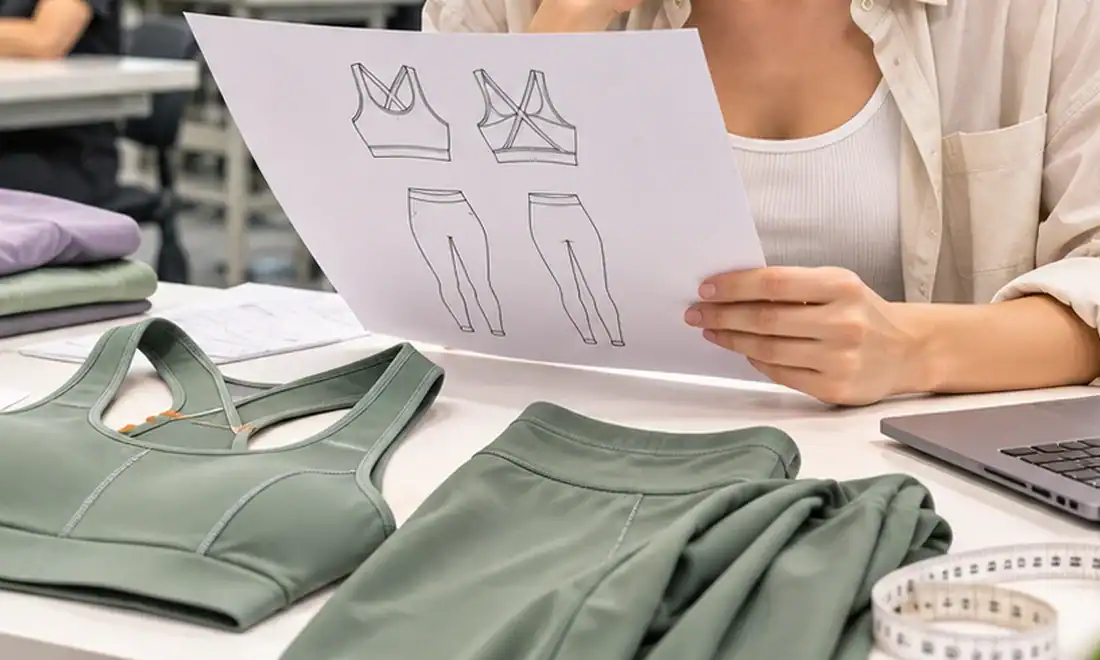
For activewear, important failure points include fabric opacity under stretch, recovery after use, shrinking or twisting after washing, color bleeding, seam breakage, uncomfortable bra bands, incorrect grading, and damaged logo applications. A reliable supplier should specify both tests and acceptance criteria, and identify the fabric lot used for sampling and bulk.
| Quality checkpoint | What to request from either factory | Purpose |
|---|---|---|
| Materials | Approved swatches, fiber blend, weight, color and supplier lot | Prevents unapproved substitutions |
| Fit and sizes | Physical pre-production samples, POM chart, grading, tolerances | Creates repeatable fit and size control |
| Leggings performance | Opacity under extension, stretch recovery, seam checks | Addresses common product complaints |
| Sports bra performance | Band and strap fit, supportive construction and movement testing | Checks comfort and functional suitability |
| Care and durability | Relevant laundering, pilling, colorfastness and logo tests | Protects repeat-use performance |
| Bulk shipment | In-line checks, final inspection report and defect remedies | Reduces unexpected shipment problems |
When relevant, ask a suitable lab or inspector to use documented test methods and report the sample identity, method, date and result. Do not treat unverified badges or blanket statements such as “100% premium quality” as proof.
Made in USA Claims, China Imports and Compliance Considerations
For brands selling into the United States, country-of-origin marketing and apparel labeling require accurate substantiation. A US office, US designer, or US shipping warehouse does not automatically mean the finished garment can be described as “Made in USA.” The Federal Trade Commission has rules and guidance for unqualified US-origin claims, while textile labeling and Customs and Border Protection requirements can also be relevant. Review the current rules for the actual manufacturing steps and your exact claim.
For finished garments imported from China, the applicable customs classification, tariff treatment, origin determination, trade measures, and importer obligations must be reviewed at the time of import. This guide intentionally gives no current duty percentage because those terms may change and depend on the product and destination. Consult a licensed customs broker or qualified trade professional when costing actual orders.
Brands also need correct fiber-content labels, care information and other legally required details for their sales markets. Do not claim certifications, recycled content, antimicrobial performance or sustainability benefits without evidence tied to the exact product and supply chain.
When Is China Better—and When Is USA Manufacturing Better?
The following are practical starting recommendations that still require supplier-specific checks. The better choice can change as your order volume, cash flow, sales market, and technical requirements evolve.
Useful to investigate when your brand has an approved tech pack, needs a particular fabric/trim supply network, can plan inventory ahead, and can manage international freight and inspection.
Useful to investigate when your US team values frequent in-person fittings, short local communication loops, domestic delivery or a substantiated domestic-production proposition.
The winning supplier is the one offering a viable minimum, high-quality sample and acceptable cash risk. Confirm small-run capabilities rather than assuming they belong to one country.
Some brands can prototype or replenish locally while using an overseas factory for an approved bulk program. Document which site owns each step and maintain consistent specs.
A Simple Weighted Supplier Scorecard
| Decision factor | Example weight | What earns a high score |
|---|---|---|
| Sample quality, fit and technical capability | 30% | Meets approved performance and construction requirements |
| Real total cost and minimum cash commitment | 25% | Documented, sustainable price and workable MOQ |
| Delivery and reorder reliability | 15% | Credible dated milestones and material continuity |
| Factory verification and QC transparency | 15% | Verified producer and clear inspection/defect process |
| Communication and development support | 10% | Clear revisions, responsive technical contact and sample process |
| Country-of-origin / market strategy fit | 5% | Accurate origin claims and appropriate market positioning |
| Total | 100% | Adapt weights to your brand and category |
Weights are illustrative, not a researched ranking of manufacturing countries. A critical failure of business identity, product safety or sample quality should override a high weighted average.
How to Compare China and USA Activewear Suppliers in 8 Steps
Define one comparable garment specification
Write a controlled tech pack with flats, fabric, GSM, measurements, grading, seam details, logos, colorways, quantity and required tests. A vague “premium gymwear” request creates incomparable quotes.
Output: one RFQ specification to send to both countries.
Confirm who actually makes the garments
Request the legal contracting company, production address, factory capabilities and any subcontracting arrangement. A distributor or domestic office does not automatically manufacture the product.
Output: production-site and contracting-entity record.
Get identical quantities and MOQ rules
Compare the same styles, colors, size ratios and order sizes. Confirm whether special fabrics, prints, cups or trims impose independent minimums.
Output: matching quantity matrix and written minimums.
Order and test physical samples
Check stretch, opacity, seams, fit, wash performance and branding. Keep the approved material code and fit measurements. Do not base the choice solely on product photographs.
Output: comparative sample approval sheet.
Build a delivered-cost worksheet
Add factory price, development, labels, inspection, freight, applicable import charges and receiving costs. Use current destination-specific figures for real orders; separate accounting inventory cost from broader cash budgets.
Output: like-for-like delivered and total-cash estimates.
Compare milestone dates, not slogans
Record sample revision time, fabric readiness, cutting start, sewing completion, final QC, shipment and warehouse arrival. Include a practical reserve for delays.
Output: dated supply-chain plan.
Check origin, labeling and legal responsibilities
Confirm where processing occurs and what the product can accurately claim. Verify market requirements, trademark and artwork protection, deposit terms, defect remedies and named shipping responsibilities.
Output: documented compliance and contract checklist.
Approve a pilot order and review actual results
Track quality, delivery, communication, sales by size, returns and reorder readiness. Let evidence from the first batch determine whether to scale with one supplier or diversify.
Output: post-production supplier scorecard.
Manufacturer Perspective: What Matters More Than the China vs USA Label?
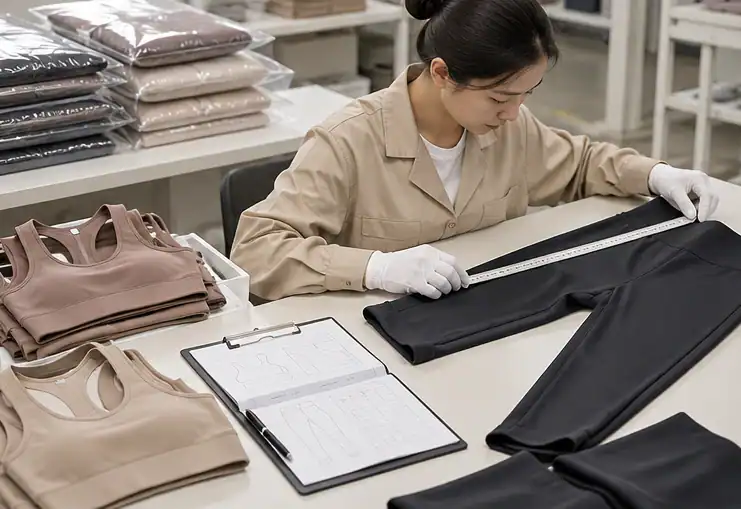
From a product-development standpoint, most avoidable production disputes are caused by ambiguous specifications, unapproved fabric substitutions, missing quality thresholds, unrecorded sample changes, or unrealistic freight assumptions. The same prevention tools work with factories in both countries: an approved tech pack, signed pre-production sample, clear BOM, measurements, written QC acceptance rules, and change control.
FreeFeel Gym Wear describes itself as a China-based OEM and private label activewear manufacturing partner. Its company-provided references include MOQ starting at 100 pieces per style/color, sample lead times of 7–10 days, bulk production of 25–35 days, 15+ years of experience, a 3,000 m² facility and 100+ workers. These are supplier-stated planning facts, not independently audited metrics or price guarantees; verify them against the actual project.
Six Mistakes in International vs Domestic Sourcing
An overseas quote may exclude duties and delivery. A domestic quote may exclude local transport and development.
Verify the actual cutting and sewing site, imported inputs and the basis for any origin claim.
Small order freight, import charges, delays, and inventory risks can change the outcome.
Fit, fabric behavior, colorfastness and workmanship still need sample and bulk inspection.
Custom colors, elastics and finishes can impose minimums beyond the garment factory's headline MOQ.
Separate production time from material sourcing, approvals, transport and actual warehouse availability.
Final Comparison Checklist
FAQ: China vs USA Activewear Manufacturing
Is it cheaper to manufacture activewear in China or the USA?
China may offer lower factory unit quotes for some products, but not necessarily a lower total landed cost. Compare the same garment and quantity, then add samples, quality checks, international or domestic freight, applicable import charges and other cash requirements. The prices in this guide are hypothetical examples, not current market rates.
Is activewear made in China lower quality?
No country label proves product quality. Factories in either country can produce excellent or poor garments. Compare technical capability, approved samples, fabric test reports, measurements, inspections and actual production consistency.
Does manufacturing in the USA mean a lower MOQ?
Not necessarily. Some US workshops may offer short runs, but minimums vary by factory, fabric and construction. Chinese suppliers also vary. Request written MOQ rules by style, color and size from each candidate.
Can a US clothing brand use a Chinese activewear manufacturer?
Yes. Many brands work with overseas manufacturers, subject to the applicable trade, labeling, payment and product requirements. Confirm the real contracting entity, production location, quality plan, origin labeling and import obligations for the intended market.
Is USA manufacturing always faster?
No. Domestic shipping can reduce some transport complexity for US buyers, but fabric availability, sampling revisions, capacity and production scheduling determine the full timeline. Some US factories use imported materials, which can affect readiness. Compare actual dates rather than national averages.
What is the MOQ at FreeFeel Gym Wear?
FreeFeel states a starting MOQ of 100 pieces per style/color, subject to product, fabric and commercial confirmation. The term is specific to that supplier's stated offer and should not be generalized to all Chinese factories.
Can I market garments as “Made in USA” if the brand is based in America?
A US business address does not automatically support a Made in USA claim. Claims must meet applicable origin and advertising requirements based on where the product and relevant components are made. Review current FTC guidance and obtain qualified advice for your actual production arrangement.
What duties apply when importing Chinese leggings into the USA?
Duties depend on current tariff classification, origin and applicable trade measures. Rates and rules can change, so this article does not give an unverified percentage. Obtain an up-to-date classification and landed-cost estimate from a qualified customs professional.
Should a startup choose private label or custom OEM in either country?
Private label can reduce pattern-development work when a suitable existing style is available. Custom OEM can give greater control over fit and construction but may require more sampling and tooling. Compare true costs and sample results from each manufacturer.
Can I split activewear production between China and the USA?
Possibly. Brands may develop or replenish some products locally while manufacturing other approved styles overseas. Maintain consistent tech packs, material approvals, sizing, labeling, quality checks and documented supplier responsibilities across sites.
Share your tech pack or sketches, fabric requirements, styles, colors, size ratio, target quantity and delivery destination. Request an itemized China manufacturing quote and compare it with a verified US proposal using the same specifications.
Explore FreeFeel Gym WearEditorial disclosure: This is a buyer's decision framework, not a live market-price survey, legal opinion or objective national ranking. All numerical cost examples are hypothetical. FreeFeel factory and lead-time information is company-provided and needs project-specific verification. Tariffs, import requirements and US-origin claim rules must be checked against current official guidance. Three images are reused AI-generated illustrations rather than photographs of actual Chinese or US factories. Linked Ohsure resources have not been live-checked.