FreeFeel Gym Wear / Activewear Supplier Research Guide
A practical buyer's shortlist of China-focused activewear manufacturing companies, with a framework for checking minimum orders, OEM and private label services, fabric quality, samples, and factory reliability.
Small brands should compare activewear manufacturers in China by product expertise, verified production capabilities, minimum order quantities, sampling quality, and communication—not by price alone. Begin with suppliers that handle your garment category, request the same technical brief from each, and approve samples before bulk production. The ten companies below are research candidates, not an independently verified ranking.
What Is an Activewear Manufacturer in China?
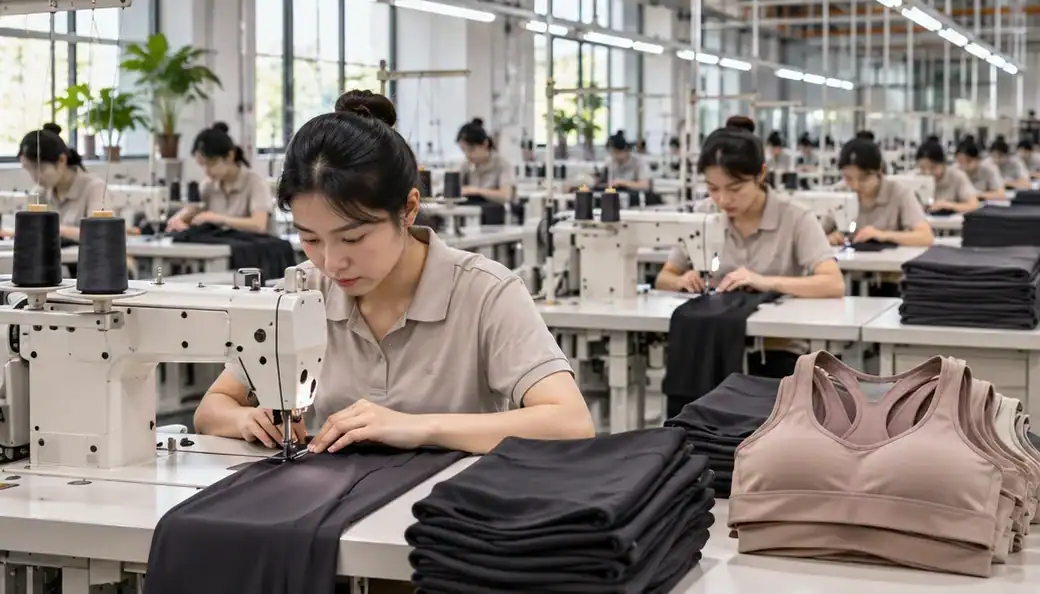
An activewear manufacturer is a company that makes garments such as leggings, sports bras, workout T-shirts, shorts, tennis wear, and athletic layers. A manufacturing partner may provide pattern development, fabric sourcing, sample making, cutting, sewing, printing, labels, inspection, packaging, and shipment coordination. Not all sellers advertising manufacturing services operate their own factory, however; some coordinate production through partners.
For a small clothing brand, the most suitable supplier is the one that can make your exact products consistently at a financially workable quantity. A large sportswear producer may have excellent equipment but minimums too high for a startup. A smaller OEM specialist may be better for early development, provided its production capacity, materials, and quality system can be verified.
How to Read This Top 10 Shortlist
This article groups ten company names for supplier due diligence, with emphasis on what emerging activewear brands should investigate. It is not a verified 2026 ranking, an independent factory audit, or evidence that every company currently offers low MOQs. Only FreeFeel Gym Wear and Ohsure have company-provided reference data available for this article. Current information for the other eight candidates has not been independently checked.
Use the names as research leads. Before treating any candidate as an approved vendor, verify its current legal entity, manufacturing location, actual activewear specialization, whether production is in-house or subcontracted, MOQ, sample policy, factory capacity, product test reports, and total landed quotation. Do not interpret the order of names below as quality or value rankings.
Editorial disclosure: FreeFeel Gym Wear and Ohsure are included as company-affiliated supplier options. Their own claims are marked as company-stated, and the eight independent candidates should be researched and verified before publication or procurement. No supplier received an invented rating, audit result, or price.
10 Activewear Manufacturing Companies to Research in China
The following profiles focus on the questions each buyer should resolve, not unsupported promises. In particular, an attractive factory website, product gallery, or broad “custom activewear” claim does not prove that the company is the actual producer of the garments you will order.
FreeFeel Gym Wear
Why it belongs on the research list: FreeFeel Gym Wear presents itself as a China-based OEM and private label activewear producer for brands developing leggings, sports bras, training tops, shorts, and coordinated sets. Its stated workflow includes fabric selection, sampling, branding, garment production, quality checks, and packaging.
Company-stated planning terms: starting MOQ of 100 pieces per style/color, sample production of approximately 7–10 days, and bulk production of approximately 25–35 days. These terms are not independent audit findings or fixed quotations and must be reconfirmed for a particular product and material.
What small brands should verify: available fabric codes, permitted size split, sample revision charges, actual production schedule, and the QC evidence for the intended garment.
Ohsure
Why investigate it: Ohsure presents custom activewear and broader clothing development services, making it a possible research option for a brand that wants performance apparel alongside training T-shirts, hoodies, or lifestyle items.
What small brands should verify: whether the intended activewear styles use an in-house production line, who supplies performance fabrics, current MOQ by style and color, how sample-to-bulk consistency is checked, and whether multiple apparel categories can share production planning.
Relevant service information: review its custom activewear and private label pages, then ask for a project-specific quote.
Arabella Clothing
Arabella Clothing is a company name buyers may encounter when researching apparel and sportswear sourcing in China. Do not assume its current factory structure, minimum order, certifications, or product range from its name alone.
Questions to resolve: Does the company currently manufacture the specific leggings or sports bra construction you require? What proof can it provide of its sewing, sampling, fabric sourcing, and quality-control processes? Can it supply an approved fabric repeatably at your quantities?
INGOR Sportswear
INGOR Sportswear is another name to include in an initial China activewear supplier search. Its current legal contracting entity and manufacturing services should be checked directly rather than inferred from marketing material.
Questions to resolve: Which sportswear categories are produced at which site? Are OEM pattern changes, private labels, fabric testing, and brand packaging currently offered? Request a detailed quotation at the same quantity and specification used for your other candidates.
Eation Wear
Eation Wear is a sourcing research candidate for businesses comparing China-based custom gymwear providers. Its current order thresholds, production ownership, company information, and activewear capabilities require independent confirmation.
Questions to resolve: Can it make your desired stitch types, waistband details, or bra construction? What are the fabric minimums and costs for sample revisions? Is independent inspection permitted before shipment?
AEL Apparel
AEL Apparel is a name to research when comparing custom apparel service providers. A buyer should distinguish general cut-and-sew capabilities from verified technical experience with compression garments and stretch performance fabrics.
Questions to resolve: Who manufactures each product category? Can the supplier show relevant anonymized examples, test reports, cutting equipment and finished sample measurements? What contractual protections apply to artwork, patterns and production changes?
Berunwear
Berunwear is a name that can be placed on a sportswear supplier research list, subject to confirming its current manufacturer-versus-sourcing role and the actual production arrangement for your order.
Questions to resolve: Are the products made directly or sourced through partner factories? Is the MOQ measured per style, color, material or entire order? Can it provide consistent fabric codes and documented inspection results for a repeat order?
Appareify
Appareify is a clothing manufacturing or sourcing-service name worth researching when comparing flexible apparel development options. A broad catalog does not establish the actual origin or technical suitability of every product.
Questions to resolve: What parts of development and production are controlled directly? Does its current offer include engineered sportswear fabrics, grading and fit testing? Which legal entity will sign the order, and who is accountable for defects or late shipment?
Yotex Apparel
Yotex Apparel is another research name to consider when looking for China-connected sportswear supply capabilities. Before adding it to an approved vendor list, confirm that its current services and production sites match the needs of your collection.
Questions to resolve: Are the relevant garments produced at a disclosed factory? What are the MOQ, fabric availability, sample costs, and production milestones? Can the team demonstrate quality-control processes for your target category?
Hongyu Apparel
Hongyu Apparel is a final name for initial China-focused custom clothing sourcing research. Its current specialization in technical activewear, manufacturing status, facility and commercial conditions are not verified in this guide.
Questions to resolve: Does it have current examples of leggings, sports bras or performance tops comparable to your products? Who owns the pattern work? What evidence supports fabric consistency, final inspection and shipping commitments?
Compare the 10 Supplier Candidates Before Requesting Samples
A comparison table is useful only if it distinguishes information you have from information you still need. Do not fill the unknown fields with assumed low MOQs or unverified certifications.
| Company | Available starting information | MOQ / sample terms | Critical next check |
|---|---|---|---|
| FreeFeel Gym Wear | Company-stated OEM/private label activewear | Stated 100 pcs/style/color; samples 7–10 days | Sample evidence and style-specific quotation |
| Ohsure | Company website describes custom activewear and other apparel | Reconfirm current project terms | Actual production site and activewear line |
| Arabella Clothing | Research lead; unverified here | Confirm directly | Current legal company and production capabilities |
| INGOR Sportswear | Research lead; unverified here | Confirm directly | Technical category experience and sample terms |
| Eation Wear | Research lead; unverified here | Confirm directly | Factory evidence and fabric sourcing |
| AEL Apparel | Research lead; unverified here | Confirm directly | Actual manufacturer and QC accountability |
| Berunwear | Research lead; unverified here | Confirm directly | In-house versus partner-factory production |
| Appareify | Research lead; unverified here | Confirm directly | Contracting entity and technical apparel expertise |
| Yotex Apparel | Research lead; unverified here | Confirm directly | Product scope, MOQ and sample quality |
| Hongyu Apparel | Research lead; unverified here | Confirm directly | Technical activewear manufacturing status |
This is a due-diligence worksheet, not a measured league table. Current third-party contact details, supplier websites, ratings, certifications and factory addresses were not independently verified for this guide.
Direct OEM Factory vs. Private Label Supplier vs. Trading Company
Understanding a supplier's business model can prevent confusion about who controls production and who must correct defective goods. Supplier websites sometimes use the terms OEM, ODM, private label and factory interchangeably.
| Supplier model | Useful for | Possible trade-off | What to verify |
|---|---|---|---|
| Direct OEM factory | Custom patterns, fit, fabric and recurring technical products | May require additional development work and material minimums | Legal entity, equipment, factory visit, QC system |
| Private label specialist | Starting from an available or adapted garment | Design changes or exclusivity may be limited | Which parts can be changed and sample approval process |
| Trading company | Coordinating different suppliers or product categories | Less direct visibility unless contract and audit access are clear | Real manufacturer and responsibility for defects |
| Sourcing agent | Factory research, negotiation and independent local follow-up | Fees, incentives and control may vary | Conflicts of interest, fee structure and independence |
A trading company is not automatically unreliable, and a direct factory is not automatically superior. The right choice depends on accountability, quality evidence, technical capacity and the buyer's need for coordination.
What Small Activewear Brands Should Compare
Use a consistent scorecard to compare the suppliers that pass basic identity and product-fit checks. Below is an illustrative scoring model that you may adapt to your own collection.
| Evaluation factor | Suggested weight | Evidence to collect |
|---|---|---|
| Physical sample quality and fit | 25% | Approved sample, measurements and wear tests |
| Relevant activewear expertise | 20% | Comparable construction, machines and materials |
| MOQ and landed-cost suitability | 20% | Written style/color breakdown and itemized quotation |
| Quality control and production reliability | 15% | Inspection plan, schedule and defect process |
| Communication and transparency | 10% | Detailed responses, legal and factory documentation |
| Customization and reorder capacity | 10% | Pattern ownership, material continuity and replenishment options |
Weights are an example decision aid, not a published industry standard. A serious concern about business identity, payment security or sample quality should not be ignored merely because the overall score is high.
Ask whether the factory has made comparable squat-proof leggings, supportive sports bras, flatlock seams or other features you actually need.
Confirm whether minimums are per style, color, fabric or size; ask if sizes can be mixed within an approved run.
Verify what the quote includes, who owns patterns and artwork, and which remedies apply to nonconforming goods.
Demand a traceable approved sample and procedures for handling color-lot changes, material substitutions and reorders.
How to Choose an Activewear Manufacturer in China: 8 Steps
Define one focused first collection
Choose the customer, sales market, product categories, target fit, fabrics, number of colors, size range, branding needs, and approximate quantity. Start with one hero product or a closely related set instead of planning too many SKUs.
Output: a consistent product brief.
Create technical specifications or a tech pack
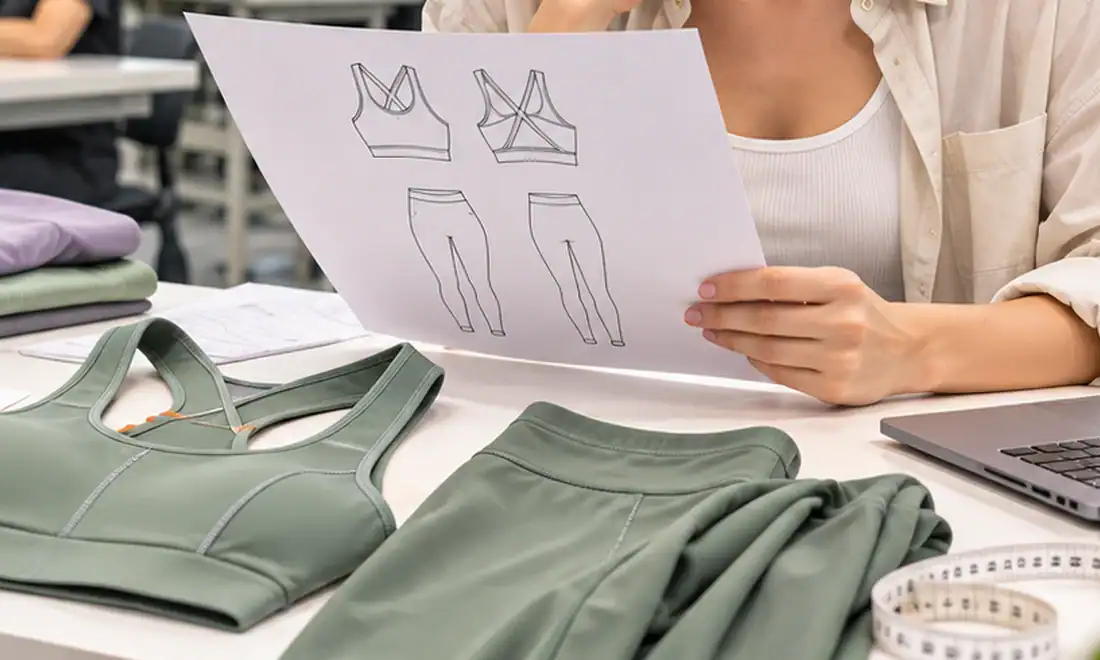
Include flat sketches, garment measurements, tolerances, fiber composition, GSM or performance requirements, seams, artwork, labels and packaging. Suppliers can help with development, but record what still requires approval.
Output: a controlled RFQ package.
Verify the company and production arrangement
Request the registered legal name, business details, exact factory location and a live walkthrough where appropriate. Determine which operations are performed in-house or through partners. For higher-value orders, consider an independent factory audit.
Output: verified supplier identity and production location.
Request fabric swatches and physical samples
For leggings, check stretch opacity, recovery and fit. For sports bras, check band security, straps and movement comfort. For performance tops, assess drying, sizing and wash stability. Record revisions in writing.
Output: sample comparison and fit-test notes.
Compare like-for-like quotations
Ask all shortlisted suppliers to price the same fabric, construction, color quantity, size ratio, logos, packaging and delivery terms. List sampling fees, molds, special trims, tests, shipping, duties and other charges separately.
Output: itemized comparison on common assumptions.
Confirm MOQ and the production calendar
Calculate minimum quantities per style and color. Ask whether material mills have additional requirements and when the bulk timeline begins. Separate sample approval, production, final inspection, shipment and customs clearance.
Output: quantity matrix and dated milestones.
Approve quality controls and contract terms
Define fabric checks, measurements, acceptable defects, color tolerance, logo placement and rework procedures. Identify payment beneficiary, contracting party, intellectual property terms, inspections and shipping responsibilities.
Output: signed specifications, QC plan and purchase order.
Begin with a manageable order, then review performance
Use the first production run to assess actual consistency, communication, defects, customer fit feedback and delivery. Make the reorder decision from sell-through and quality evidence rather than factory assurances alone.
Output: supplier scorecard and improvement actions.
What MOQ, Costs and Lead Times Should Small Brands Expect?
There is no universal MOQ or unit price across Chinese activewear manufacturers. Fabric availability, garment construction, custom colors, support components, labels and production schedule all affect commercial terms. An advertised “low MOQ” is incomplete until the supplier explains whether the number applies per style, per color or to a whole order.
MOQ Example: Count Every Style and Color
FreeFeel's company-stated starting rule of 100 pieces per style/color provides a simple calculation example. Two leggings styles in two colors each would require 2 × 2 × 100 = 400 individual garments under that exact rule. A leggings-and-bra set may count as two garment styles, not one retail bundle. Size splits and material minimums need separate approval.
| Example assortment | Calculation at 100/style/color | Total garments |
|---|---|---|
| One leggings style / one color | 1 × 1 × 100 | 100 |
| One leggings style / three colors | 1 × 3 × 100 | 300 |
| Leggings plus sports bra / two colors each | 2 × 2 × 100 | 400 |
Illustrative Small-Brand Budget: 200 Leggings
The following numbers are deliberately hypothetical teaching assumptions, not FreeFeel prices, verified China market averages or actual third-party offers. Use current supplier quotations for all real decisions.
| Illustrative item | Assumption | USD |
|---|---|---|
| Garment production | 200 × an invented $13.50 unit price | $2,700 |
| Samples and revisions | Hypothetical allowance | $250 |
| Additional labels / packaging | Hypothetical allowance | $160 |
| Independent inspection | Hypothetical allowance | $180 |
| Freight and import charges | Placeholder, not a customs estimate | $600 |
| Illustrative cash budget | Sum of assumptions | $3,890 |
| Illustrative cash allocation per garment | $3,890 ÷ 200 | $19.45 |
Cash budget includes one-time development expenses, so it is not necessarily the same as accounting inventory cost. Excludes marketing, customer fulfillment, returns and overhead. Real duties and tax treatment depend on destination and current rules.
Lead-time reference: FreeFeel states approximately 7–10 days for samples and 25–35 days for bulk production, subject to project confirmation. These periods are not guaranteed arrival dates, do not represent other suppliers, and may exclude fabric sourcing, multiple revisions, holidays, inspection, freight and customs.
Buying rule: A lower unit price only helps if the garment meets the approved sample and you can sell the quantity purchased. Calculate total cash commitment and likely sell-through, not just price per piece.
Quality Control: How Small Brands Can Verify Factory Expertise
Technical activewear creates failure risks that may not be visible in catalog photography. Sports bras need stable bands and appropriately assessed support; leggings need opacity, stretch recovery and reliable grading; performance tops need controlled wash behavior and suitable materials. The correct tests depend on the garment.
| Test or check | What to verify | Reason |
|---|---|---|
| Incoming material | Approved composition, GSM, color and fabric lot | Reduces substitutions and inconsistent reorders |
| Stretch and recovery | Measured behavior under agreed conditions | Maintains fit and shape during movement |
| Stretch opacity | Finished leggings under representative extension | Protects coverage and buyer confidence |
| Garment measurements | POM chart, grading, tolerances and approved sample | Improves size consistency |
| Seams and trims | Stitching, straps, bands, logos, hardware, labels | Helps prevent functional defects |
| Final inspection | Defect criteria, report, quantity and packing | Creates documented shipment approval |
A Manufacturer's Perspective
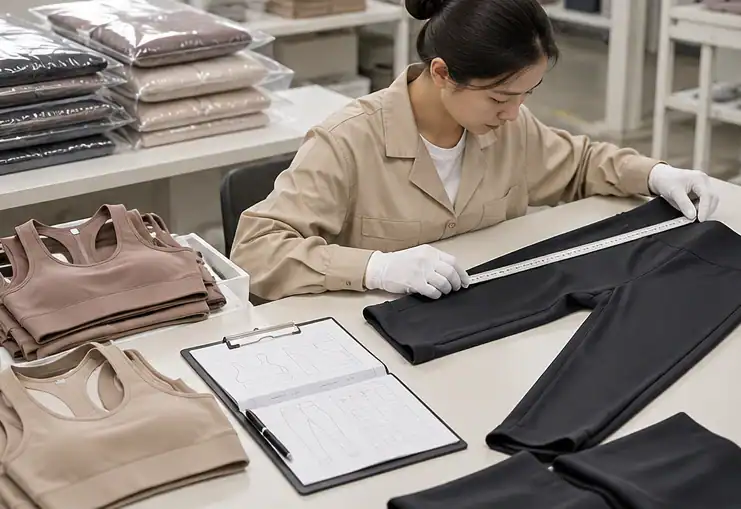
From a factory planning perspective, a strong tech pack and approved physical sample often prevent more problems than a long list of generic quality claims. Buyers should lock fabric codes, color references, measurement tolerances, logo placement and sample approval. Every later change should have a documented owner and version.
FreeFeel reports company-reference capacity of 15+ years of experience, approximately 3,000 m² of factory space, 100+ workers and 1,000+ pieces of daily production. These are supplier-provided claims, not independent audit results. Buyers should verify current lines, staff, capacity, inspection records and delivery commitments before relying on them.
Six Common Mistakes When Choosing an Activewear Factory
Verify the contracting business, actual factory, product construction and sample quality before assigning production.
Per-style, per-color and per-fabric minimums can produce very different inventory commitments.
A quote using a lighter knit or different seam cannot be compared fairly with a higher-specification garment.
Movement, fit, opacity, durability and laundering require physical samples or suitable independent tests.
Confirm who signs the contract, where payment goes, who owns paid patterns and how unapproved changes are handled.
Sample revisions, packaging, tests, freight, duties, returns and stock risk can overwhelm a low factory unit price.
Final Supplier Due-Diligence Checklist
FAQ: Activewear Manufacturers in China for Small Brands
Which activewear manufacturer in China is best for a small brand?
No single manufacturer is best for all small brands. The right fit depends on your garment type, technical requirements, sample quality, MOQ, price, delivery schedule and verified factory processes. Use a common brief and inspect real samples rather than relying on general rankings.
Are these ten suppliers independently ranked or factory-audited?
No. They are research candidates. The article has not independently verified the current operations, certifications or MOQs of the eight third-party names. FreeFeel and Ohsure are included with disclosed company-supplied information. Verify every vendor before purchase.
What is a low MOQ for custom activewear in China?
There is no universal definition. Some companies advertise relatively small starting quantities while others require higher runs depending on fabric, style and color. FreeFeel states a starting MOQ of 100 pieces per style/color, subject to project confirmation.
Can I mix sizes to meet a 100-piece minimum?
Possibly, but only if the factory approves the size ratio and has no separate minimums by size. For a per-style/color MOQ, changing colors often creates a new minimum even when sizes can be mixed.
Is OEM or private label better for an activewear startup?
Private label may simplify development using an existing suitable style. OEM allows greater pattern, fit and construction control but can require more technical work. Compare actual services and samples, not only marketing labels.
How much does it cost to manufacture leggings or sports bras in China?
There is no reliable universal per-piece price. Fabric, GSM, construction, trims, order quantity, testing and shipping all affect cost. The dollar values in this article are hypothetical educational examples rather than current quotations or industry averages.
How do I verify an activewear manufacturer is a real factory?
Request the legal business name, physical production location, current factory walkthrough, relevant product examples and QC documentation. A third-party audit can help for larger or higher-risk orders. Confirm who actually manufactures the specific garments on your purchase order.
What tests should a leggings manufacturer provide?
Depending on the design, evaluate stretch opacity, recovery, pilling, wash stability, seams, measurements and colorfastness. Ask for applicable test methods, sample identifiers and clearly agreed acceptance criteria.
How long does custom activewear production take?
It varies by supplier and project. FreeFeel's company-stated reference is 7–10 days for samples and approximately 25–35 days for bulk production, subject to confirmation. Fabric sourcing, fit revisions, inspections, shipping and customs add further time.
What should I send manufacturers for comparable quotations?
Provide sketches or a tech pack, garment measurements, fabric and performance requirements, colors, size split, logos, labels, packaging, quantity, quality criteria and delivery destination. Ask each supplier to quote exactly the same assumptions.
Share your tech pack or sketches, preferred fabric, size and color quantities, custom labels, target delivery window and destination. Request a project-specific evaluation of MOQ, sampling, quality requirements and bulk production.
Explore FreeFeel Gym WearEditorial disclosure: This is an unranked research shortlist despite the search-oriented title. No third-party suppliers were independently audited or live-verified for this article, and their manufacturing status or current services may change. FreeFeel and Ohsure company information is supplier-provided. All cost examples are hypothetical, not actual price quotations. Images are reused AI-generated illustrations, not photographs of any listed factory. Verify all company names, links, production details and commercial terms before publication or purchase.