FreeFeel Gym Wear / Product Development Guide
An actionable guide for fitness apparel brands creating leggings, sports bras and gymwear—complete with a specification checklist, sample measurement chart, bill of materials, quality criteria and revision workflow.
To create an activewear tech pack, document the garment design, front and back technical drawings, fabric and trim specifications, measurements, size grading, construction details, branding, labels, and packaging. Add measurable quality requirements, an approved color list, and revision history. Share the pack with your manufacturer, review a physical sample, correct discrepancies, and approve a final version before bulk production.
What Is an Activewear Tech Pack?
An activewear tech pack (technical package) is the controlled set of instructions a clothing manufacturer uses to develop and produce a garment. It translates a brand's concept into drawings, measurable dimensions, fabric and trim requirements, construction methods, artwork and labeling specifications, and approval criteria. The pack should identify its style code, revision number, date, owner, and any approved changes.
A tech pack is different from a mood board, which communicates inspiration, or a product photo, which shows an appearance but not the exact pattern or quality standard. A pattern defines shapes for cutting; a tech pack explains what those pieces should become and how the resulting product will be checked. Factories may help develop patterns, but that does not make an incomplete tech pack production-ready.
For technical sportswear, the pack also needs product-specific information: legging stretch direction and opacity, sports bra band and strap specifications, activewear seam extension, or moisture-management claims with suitable test methods.
What Should Be Included in an Activewear Tech Pack?
The following modules form a practical minimum for requesting samples and manufacturing quotations. Some products need additional pages for padding, bonded seams, prints, or special components.
| Section | Essential fields | What can go wrong if omitted |
|---|---|---|
| 1. Cover & control | Brand, style code, item name, date, revision, contact, units | Different teams use different versions |
| 2. Technical flats | Front, back, side or detail sketches with callouts | Silhouette and seam lines are misinterpreted |
| 3. Materials / BOM | Fabric blend, GSM, knit, trims, colors, supplier codes | Wrong fabric or elastic is substituted |
| 4. POM measurements | How to measure, base size, tolerances, finished-garment dimensions | Fit and finished sizes drift |
| 5. Size grading | Approved size range and size-to-size measurements | Non-base sizes are inconsistent |
| 6. Construction | Stitch type, seam location, allowances, reinforcements, finishing | Samples and bulk garments are built differently |
| 7. Color & branding | Color references, logo method, dimensions, placement and artwork | Incorrect shades, scale or artwork position |
| 8. Labels & packing | Care label, fiber content, size tag, hang tag, folding, bag and carton | Packaging errors and possible compliance problems |
| 9. QC & approval | Test plan, defect rules, sample comments, approval signatures | No objective standard for production release |
Keep every section traceable to one style and revision. For a matching set, use separate garment specifications for the sports bra and leggings while sharing a collection-level color and branding reference where helpful.
Technical Flat Sketches and Construction Callouts
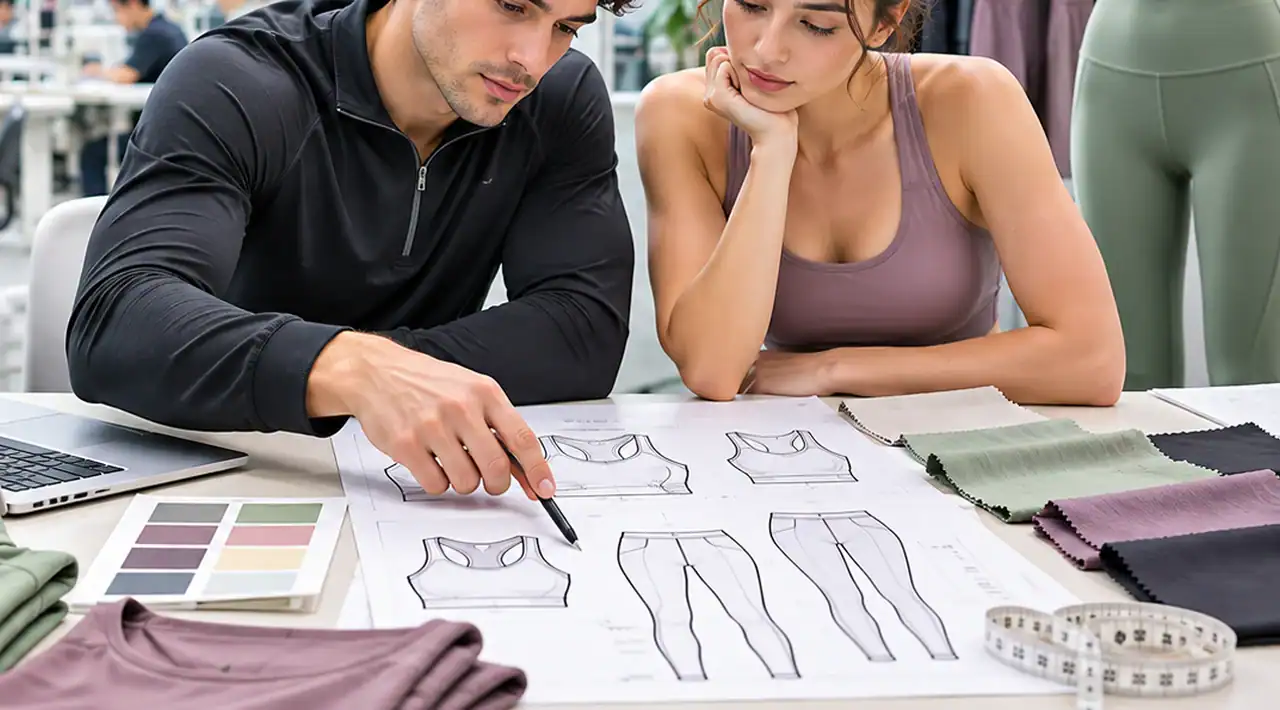
Technical flats are simplified front and back garment drawings intended to show proportion, panel boundaries, seam lines, pockets and components without the distractions of a fashion illustration. Each visible detail should point to a specific written instruction where needed.
Show waistband height, rise, inseam, gusset, side seams or seamless panels, pockets, hem, logo placement and any contour seams.
Show front neckline, back straps, underband, lining, pad access, elastic attachment and closure details if relevant.
Show neckline shape, shoulder seam, sleeve opening, ventilation panels, hems, print position and any reflective details.
Show inseam, waistband construction, pocket openings, liner, gusset, side vents and drawcord specifications.
A useful callout is specific: "Side seam: 4-thread overlock, seam allowance 6 mm; test extension on approved fabric" communicates more than "strong stitching." The callout must reflect the actual factory method approved for that garment; the example is not a universal instruction for all activewear.

Activewear Measurement Sheet: A Leggings POM Example
A POM (point of measure) defines a repeatable location and technique for measuring a finished garment. The size chart in a tech pack normally describes garment measurements, which are not the same as a consumer's body-measurement chart. Clearly state whether a measurement is a full circumference, a flat half-width, or a length.
The following women's high-waist leggings chart is an invented teaching example in centimeters. It is not a fit recommendation, an established US/EU size standard, or an approved FreeFeel pattern. Validate every measurement against fit samples, target body measurements, pattern stretch and size grading before any bulk order.
| POM (finished garment) | XS | S | M | L | XL | Example tolerance |
|---|---|---|---|---|---|---|
| Waistband relaxed circumference | 56 | 60 | 64 | 68 | 72 | ±1.0 cm |
| Hip circumference at defined point | 76 | 80 | 84 | 88 | 92 | ±1.0 cm |
| Front rise (defined path) | 24 | 25 | 26 | 27 | 28 | ±0.7 cm |
| Inseam | 65 | 66 | 67 | 68 | 69 | ±0.8 cm |
| Outseam (defined reference) | 84 | 85.5 | 87 | 88.5 | 90 | ±1.0 cm |
| Leg opening circumference | 18 | 19 | 20 | 21 | 22 | ±0.7 cm |
Important: An unexplained “waist 64” is ambiguous. It might mean a circumference or a flat width, and measurement methods can differ. Add a numbered POM diagram and instructions such as “lay flat without stretching; measure at top edge; double the half-width” when that method is intended.
How to Handle Grading and Tolerances
Grading expresses how pattern measurements change across sizes. It is not necessarily a fixed increment for every POM. In the example, hip circumference increases by 4 cm per size, while inseam increases by 1 cm. Real rules depend on fit strategy and size research. Tolerance is the acceptable deviation of a finished production garment from an approved measurement; it is not the same as the grading increment.
Have the fit team confirm whether the sample is measured relaxed, after laundering, or under tension. For sensitive dimensions such as bra underband or leggings waistband, record both the measurement method and any relevant stretch recovery requirements.
Example BOM: Fabric, Elastic, Labels and Packaging
The bill of materials (BOM) lists every material and component that the factory must source or make. Use supplier codes and approved standards where available, not vague descriptions like “soft fabric.” Record permitted substitutions and the approval owner.
| Component | Example specification | Approval reference | Why it matters |
|---|---|---|---|
| Main fabric | Hypothetical 75% nylon / 25% elastane, 220 GSM interlock | Swatch code FAB-01 + color lab dip | Fit, opacity, stretch, shrinkage and price |
| Waistband fabric | Same approved body fabric, double-layer construction | Construction drawing C-02 | Support and stability |
| Sewing thread | Color-matched stretch-compatible thread specification | Thread code TR-01 | Seam durability and appearance |
| Heat-transfer logo | Single-color logo, exact dimensions and location to be approved | Artwork revision ART-03 | Brand accuracy and wash durability |
| Care / size label | Market-appropriate fiber, care and size information | Label proof LAB-02 | Accuracy and compliance |
| Individual packaging | Approved folding method, bag type and SKU label | Pack spec PKG-01 | Correct receiving and presentation |
Every specification and code above is illustrative. Confirm material performance, labeling obligations, and any claimed recycled content or certifications for the actual product and destination market.
Colorways and Artwork Need Their Own Page
Assign each color a clear code, name and approved physical reference. Record logo dimensions in millimeters, exact offset from a named seam or POM, application technique and permitted placement tolerance. For heat transfers, specify durability testing and care requirements. If a supplier changes material, color or artwork method, require written approval and an updated pack version.
How to Create an Activewear Tech Pack in 9 Steps
Define the product and target wearer
Specify the garment type, intended activity, market, fit, price positioning, size range and initial colorway plan. Separate mandatory performance requirements from optional design preferences.
Deliverable: style brief with unique product code.
Prepare front, back and detail flats
Draw each seam, panel, opening, waistband, pocket and functional component. Assign callout identifiers so a manufacturer can trace the drawing to instructions.
Deliverable: labeled technical sketches.
Build the BOM and color reference
List fabrics, elastics, linings, thread, zippers, labels, artwork and packaging. Request supplier swatches and record approved fabric codes, GSM and performance requirements.
Deliverable: bill of materials and approved swatch list.
Create the base-size POM chart
Choose a base size and specify each finished-garment measurement with a numbered diagram and clear measuring method. Define whether entries are full circumference or flat width.
Deliverable: base-size measurement specification.
Add size grading and tolerances
Work with a pattern maker to validate changes across XS–XL or the required range. Record finished measurement targets separately from permitted production deviations.
Deliverable: graded chart and tolerance table.
Specify stitches, seams and finishes
Describe seam types, edge finishing, reinforcement, allowances, pocket assembly, pads or bands, with factory-compatible methods confirmed during sampling. Add close-up diagrams when necessary.
Deliverable: construction specification.
Include branding, labels and packing
Attach vector logo files, print dimensions, placement references, colorways, required label information and packaging instructions. Confirm claims and labeling for target markets.
Deliverable: artwork, label and packaging sheet.
Set quality tests and request a prototype
Choose checks relevant to the garment: squat opacity and recovery for leggings, dynamic fit and band stability for sports bras, or shrinkage and print durability for training tops. Review physical samples and record feedback by version.
Deliverable: test plan, sample and revision log.
Approve the pre-production pack and freeze the version
Reconcile all sample changes with drawings, BOM, measurements, colors and construction. Sign off a version-numbered pack and pre-production sample before committing to bulk cutting.
Deliverable: controlled, production-approved tech pack.
Quality Requirements, Sample Feedback and Version Control
A good tech pack makes acceptance criteria visible before production. For leggings, prioritize garment measurements, stretch opacity, recovery, seam extension, pilling and wash stability as appropriate. For sports bras, specify underband and strap performance, support-related fit testing, cup or pad alignment, construction and care performance. Test methods and thresholds should fit the actual product, not a generic universal template.
| Quality area | What the tech pack should state | Approval evidence |
|---|---|---|
| Measurements | Numbered POMs, measuring method, allowed tolerances | Measured sample report |
| Fabric behavior | Stretch/recovery, opacity, colorfastness, dimensional stability | Swatch and relevant test report |
| Construction | Approved seam type, stitch quality, reinforcement and trims | Sample inspection and photos |
| Branding | Artwork file, size, position and durability expectations | Signed artwork proof and test |
| Label / packing | Proofed fiber/care/size labels, SKU pack counts | Approved packaging mockup |
| Final production release | Defect handling, inspection timing, sample match requirements | Signed pre-production approval |
Example Revision Log
| Version | Change | Action required |
|---|---|---|
| V1.0 / first sample | Initial design and base measurements | Fit and fabric review |
| V1.1 / revision | Waistband height adjusted; update POM-04 | New sample and revised drawing |
| V1.2 / revision | Heat-transfer location changed | New artwork proof and durability confirmation |
| V2.0 / approved | All approved sample changes consolidated | Bulk approval with signatures/date |
The version names above are examples. The critical practice is ensuring that each changed file has an owner and date, and that the factory uses the same approved revision for purchasing, sampling, cutting, sewing and inspection. Avoid change requests scattered across unrelated chat messages.

How Much Does a Tech Pack Cost and How Long Does It Take?
The cost and time required to prepare a tech pack depend on how much development already exists. A simple private-label style based on an approved factory pattern may need fewer new drawings and measurements than a highly engineered custom sports bra with molded cups, several sizes and multiple fitting rounds. Pricing models can be per style, hourly or bundled with sample development.
A clear specification, existing flats and approved pattern reduce work; an idea or inspiration photo requires additional design decisions.
Extra panels, pockets, support components, bonded seams and grading increase documentation and sample work.
Changes after fit approval may require revised drawings, material lists, pattern work and a new physical sample.
Custom fabric, colorways, brand trims and minimum dye lots affect when the approved design can enter production.
Illustrative planning timeline: A brand might plan technical documentation, one or more sample rounds, review/approval, and bulk production as separate milestones. Do not assume the tech pack eliminates the need for a physical pre-production sample. FreeFeel Gym Wear states company-reference lead times of 7–10 days for samples and 25–35 days for bulk production, subject to fabric and project confirmation; these are not guaranteed tech-pack preparation times.
Budget recommendation: Ask suppliers or designers to quote the tech pack, grading, pattern, sample rounds, testing and ownership of files separately. Never assume a low sample fee includes complete editable development files or unlimited revisions.
A Manufacturer's Perspective: Common Tech Pack Mistakes
Manufacturing problems often begin with a specification gap, not a sewing failure. A leggings tech pack that says “premium fabric, tight fit, flat seams” leaves critical questions unanswered. The factory still needs the exact material, stretch behavior, sample reference, measuring method, approved seams and acceptance criteria.
FreeFeel Gym Wear describes its China-based OEM and private-label operations as including fabric selection, product development, sampling, labels, packaging and quality checks. Its stated company references are 15+ years of manufacturing experience, a 3,000 m² facility, 100+ workers, MOQ from 100 pieces per style/color, samples in 7–10 days and bulk production in 25–35 days. These are company-provided planning statements, not independently audited guarantees; confirm them for the actual style, materials and schedule.
Images show appearance, not reliable measurements, seams, hidden components or assembly instructions.
A waist body circumference is not the same as a finished, relaxed leggings waistband measurement.
“75/25 stretch fabric” without structure, GSM, finish, code or tests permits inconsistent substitutions.
“Good quality” is not enough for a measurable pass/fail manufacturing standard.
Production teams may cut to older patterns or apply outdated logo and labeling instructions.
A good base-size sample does not guarantee consistent fit across XS–XL or extended sizes.
Final Tech Pack Release Checklist
FAQ: Activewear Tech Packs for Clothing Manufacturers
What is an activewear tech pack?
It is a version-controlled set of garment production instructions, usually including technical flats, materials, measurements, grading, construction, branding, packing and quality standards. It helps the manufacturer produce and inspect the approved design consistently.
Do I need a tech pack for private label activewear?
Even if the manufacturer supplies an existing pattern, record the selected style, size specification, fabric, colors, logo placement, labels, packaging and approvals. A full custom pack may not be necessary, but a controlled order specification still is.
What is the difference between a tech pack and a sewing pattern?
A pattern provides shapes to cut; a tech pack documents the overall garment requirements and production checks. Both may be needed for custom development, and their ownership should be agreed with the supplier or designer.
What is a POM in apparel manufacturing?
POM means point of measure. It identifies exactly where and how to measure a garment. A POM chart should make clear whether dimensions are full circumferences, half-widths, or lengths, and define permissible tolerances.
Does a tech pack need every size measurement?
For bulk production in multiple sizes, a validated grading chart is strongly recommended. At minimum, agree on the base size, size increments or targets, tolerance and how fit will be checked in other sizes.
Which software is best for creating a tech pack?
Brands use design software for flats and spreadsheets, documents or dedicated product-lifecycle tools for specifications. Choose a format your manufacturer can access, review and version reliably; clarity and approval control matter more than the software brand.
How much does it cost to create a tech pack?
Costs depend on complexity, the number of styles, available pattern work, size grading, test requirements and revision rounds. Request an itemized quote; this article does not provide invented market-average fees.
Can a manufacturer create my activewear tech pack?
Some OEM or private-label factories offer technical development services. Ask what is included, who owns editable design files and patterns, whether revisions cost extra, and how sample approval is documented.
What should I include for leggings versus sports bras?
Leggings need waist, hip, rise, inseam, gusset, stretch/opacity and seam specifications. Sports bras additionally need band, strap, cup/pad, lining, support and dynamic-fit details. Both need quality and care requirements.
Should I update the tech pack after sample revisions?
Yes. Update drawings, measurements, BOM, construction and artwork to reflect approved changes, record the revision, and obtain written pre-production approval. Do not let old files guide bulk production.
Share your garment sketches, existing measurements, preferred fabric, size range, colors, branding and target order quantity. Request a project-specific assessment of product development, samples, quality criteria and manufacturing requirements.
Explore FreeFeel Gym WearEditorial note: All BOM codes, dimensions, POM tolerances and revision examples are fictional learning aids, not approved manufacturing specifications. FreeFeel capacity, MOQ and timing figures are company-provided and require project-specific verification. Images are reused AI-generated editorial illustrations, not documentary factory photographs. Ohsure links have not been live-checked.