FreeFeel Gym Wear / Performance Fabric Sourcing Guide
Compare nylon, polyester, spandex, cotton, merino wool, and regenerated cellulosic blends. Learn how fabric structure, GSM, stretch, and testing affect leggings, sports bras, training tops, and your next collection.
The best activewear fabric depends on the activity and garment. Nylon-spandex and polyester-spandex blends are common candidates for leggings and sports bras, while engineered polyester knits are often practical for training tops. Evaluate stretch recovery, opacity, breathability, moisture management, durability, and care performance—not fiber names alone. Before bulk production, approve fabric swatches and test finished samples under realistic use conditions.

What Makes a Fabric Suitable for Activewear?
Activewear fabric is a textile selected or engineered to meet the movement, comfort, appearance, and durability demands of exercise or fitness-inspired clothing. Performance comes from the combined effects of fiber content, yarn, knit or weave construction, weight, finishing, garment design, and fit.
Brands often ask which fabric is “best for gymwear,” but a breathable running shirt, compressive training leggings, soft studio yoga top, and wind-resistant jacket do not need the same properties. A supplier should first understand the activity, expected sweat level, garment support requirements, climate, and customer preferences.
Assess how the fabric extends with movement and returns toward its original dimensions after repeated wear.
Consider wicking, drying behavior, air permeability, next-to-skin feel, and the intended training environment.
Check coverage under stretch, hand feel, compression, and support where relevant to leggings and bras.
Review pilling, abrasion, colorfastness, seam compatibility, shrinkage, and performance after laundering.
Best Activewear Fabrics Compared: Nylon, Polyester, Spandex, Cotton, and More
The table compares common fiber families and blends. These are typical sourcing considerations, not guarantees: different fabrics with the same composition can behave very differently because of yarn, knitting, treatment, and quality level.
| Fabric / fiber | Potential strengths | Limitations to evaluate | Where to consider it |
|---|---|---|---|
| Nylon / polyamide | Often soft, resilient and abrasion-resistant in suitable constructions | May retain more moisture than some polyester options; cost and hand feel vary | Leggings, yoga sets, fitted sports bras |
| Polyester | Versatile, dimensionally stable, commonly used in engineered quick-drying sports textiles | Wicking and odor performance depend on fabric design and finishes | Training tops, shorts, leggings, lightweight layers |
| Spandex / elastane | Provides elastic extension and recovery when blended appropriately | Usually a blend component, not a stand-alone garment fabric; heat and care matter | Leggings, sports bras, compression garments |
| Cotton | Natural hand feel, softness, broad availability | Can hold moisture and dry slowly during heavy-sweat workouts | Low-intensity activities, lifestyle tees, hoodies |
| Merino wool blends | Thermal comfort and odor-management potential in suitable garments | Higher sourcing complexity, care considerations, variable durability | Outdoor training, base layers, cooler-weather pieces |
| Lyocell / modal blends | Soft drape and comfort-focused hand feel | Recovery and abrasion performance require testing; often blended | Studio tops, athleisure, low-impact movement |
| Recycled polyester / nylon | Can incorporate verified recycled feedstock without changing fiber family | Recycled content is not a performance or environmental-impact guarantee | Products with documented recycled-content objectives |
Terminology: nylon is a type of polyamide; spandex and elastane refer to the same elastic fiber family. “Bamboo fabric” is often bamboo-derived viscose/rayon rather than mechanically processed natural bamboo fiber—check the actual fiber label.
The strongest fabric choice comes from matching your target garment to a specific tested textile, rather than choosing a fiber based only on an advertising claim. For a deeper product-development perspective, see the Ohsure Fabric Guide (on a separate website).
Nylon vs. Polyester for Activewear: Which Should Brands Choose?
Nylon (polyamide) is frequently shortlisted for leggings and yoga sets when a brand wants a particular smooth hand feel and fitted appearance. Polyester is widely used across performance tops, shorts, and leggings because suppliers offer many knit structures, weights, and finishes. Neither fiber is automatically superior for every use.
| Decision point | Nylon-focused blend | Polyester-focused blend |
|---|---|---|
| Softness and hand feel | Often selected for soft, smooth yoga-oriented finishes | Can also be very soft with suitable filament, knit, and finishing |
| Moisture handling | Evaluate drying and wicking on the actual textile | Many engineered moisture-management options available |
| Durability | Good options for abrasion resistance; test pilling | Good options for shape retention; test abrasion and snagging |
| Leggings coverage | Determined by knit density, color, weight, and stretch | Likewise determined by construction, not fiber name |
| Price and supply | Depends on grade, availability, and specific fabric | Depends on grade, finish, supplier, and purchase volume |
Practical selection: for a high-stretch yoga legging, sample both a nylon/elastane interlock and a polyester/elastane interlock at an appropriately comparable weight. Test fit, opacity, recovery, pilling, and wash performance. For a running top, evaluate lighter engineered polyester knits for drying and comfort, but still verify actual test results.
Fabric Construction, GSM, and Four-Way Stretch Explained
GSM (grams per square meter) measures a fabric's areal mass. It is not a quality score. Two 240 GSM fabrics can differ in density, stretch, opacity, warmth, air permeability, drape, and price. Brands should select GSM together with knit structure and intended use.
Jersey is often used for tops and softer garments; interlock can provide a denser, stable double-knit structure; tricot and other warp knits can suit particular stretch and performance applications; rib adds texture and variable elasticity; and mesh is used where ventilation is needed. Each family includes many variations.
Illustrative GSM Starting Points for Sample Discussions
| Garment | Exploratory fabric weight | What matters more than GSM alone |
|---|---|---|
| Lightweight training top | About 130–190 GSM | Air permeability, drying behavior, opacity, hand feel |
| Performance leggings | About 200–300 GSM | Stretch opacity, recovery, waistband stability, coverage |
| Sports bra body fabric | About 200–300 GSM | Construction, lining, band and strap support, movement comfort |
| Stretch gym shorts | About 160–240 GSM for selected knit styles | Movement, abrasion, liner, pocket and waist design |
These broad bands are illustrative design-conversation starting points—not standards, required ranges, or supplier commitments. Woven shorts, compression products, mesh panels, and specialty constructions may fall outside them.
Two-way vs. four-way stretch: brands commonly use “two-way” for fabric that extends mainly in one principal direction and “four-way” for extension across length and width. The terms are informal marketing language. Request a measured stretch and recovery test in both directions, including behavior after repeated cycles. Elastane percentage alone cannot predict final garment support.
What Is the Best Fabric for Each Activewear Product?
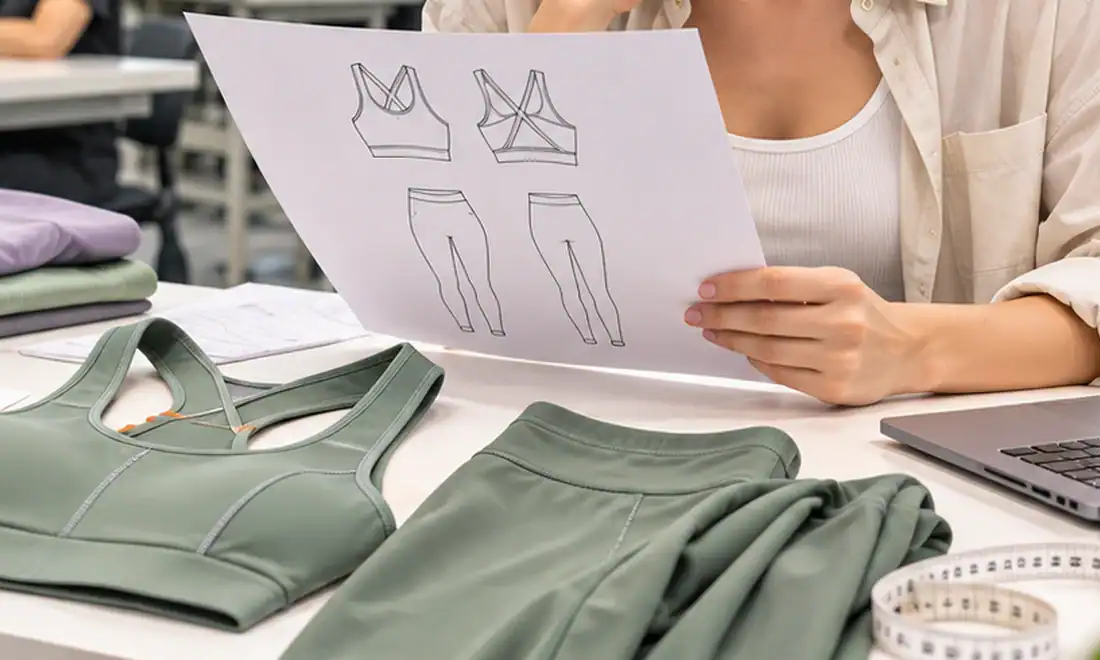
Use the garment's highest-risk failure point to guide fabric selection. For leggings that might be opacity or recovery; for a sports bra it may be support and comfort; for a running top it may be overheating or slow drying.
| Product type | Fabric candidates to sample | Priority acceptance tests |
|---|---|---|
| Yoga leggings | Nylon/elastane or polyester/elastane interlock; selected rib structures | Squat opacity, stretch recovery, pilling, fit after wash |
| High-impact sports bras | Supportive synthetic stretch blends with appropriate lining | Band and strap behavior, support in motion, seam durability |
| Training T-shirts | Engineered polyester jersey or mesh; selected blended knits | Drying, wicking, air permeability, shrinkage, odor after care |
| Gym shorts | Stretch knit or lightweight performance woven depending on design | Mobility, abrasion, liner comfort, pocket and seam performance |
| Studio / athleisure tops | Nylon blends, cotton blends, modal/lyocell blends | Drape, softness, wash stability, pilling, shape retention |
| Running jackets | Lightweight woven synthetics with selected finishes | Wind resistance, breathability, seam and zipper performance |
| Compression wear | Engineered elastic knits selected for measured pressure targets | Fit and pressure consistency, recovery, abrasion, seam extension |
A leggings fabric that feels excellent in a showroom can still become sheer under extension. A running top that feels light may not dry as intended. Ask your manufacturer to test finished garments on representative wearers, not only fabric swatches on a desk.
Essential Fabric Tests and Tech-Pack Specifications for Brands
Good fabric sourcing produces a measurable specification sheet. Before a supplier quotes bulk production, document the fabric identity and define how it will be approved and tested.
| Check | Record or test | Why it matters |
|---|---|---|
| Fiber composition | Actual declared blend and supplier material code | Prevents unapproved substitution and mislabeling |
| GSM and usable width | Measured weight and cutting width, with agreed tolerance | Affects consistency, yield and costing |
| Stretch and recovery | Extension and recovery in both directions under agreed method | Controls fit and shape retention |
| Opacity under stretch | Defined motion/extension and lighting conditions | Especially important for leggings |
| Colorfastness | Washing, perspiration, rubbing, and light where relevant | Reduces fading and color transfer |
| Dimensional change | After defined wash and dry cycles | Prevents unexpected size changes |
| Pilling and abrasion | Appropriate test method and acceptance grade | Helps predict visible wear |
| Safety and compliance | Applicable market requirements and verifiable scope of reports | Supports legitimate claims and product compliance |
Ask the laboratory or manufacturer to identify the specific ISO, AATCC, ASTM, or other appropriate method, conditioning, sampling, and acceptance thresholds used. A report without a linked fabric lot, product identifier, method, and date is less useful. Certifications such as OEKO-TEX STANDARD 100 have defined scopes and should be checked rather than assumed to cover every garment.
What to Send in a Fabric RFQ
Are Recycled, Bamboo, and Natural Fabrics Better for Activewear?
Environmental and material claims require more care than a simple “eco-friendly fabric” label. Recycled polyester and recycled nylon may use verified recycled feedstock, but the amount of recycled content, sourcing process, energy use, dyeing, durability, and end-of-life outcomes still matter. Synthetic textiles can also shed microfibers in use and washing.
Lyocell, modal, and viscose are regenerated cellulosic fiber families. Some brands use them for softer athleisure products, but manufacturing routes and sourcing differ. “Bamboo” on a sales sheet may refer to viscose made from bamboo-derived cellulose, not an untreated natural bamboo fiber. Confirm correct fiber identification and permitted labeling claims.
Organic cotton can be appropriate for casual gym lifestyle apparel, but its moisture absorption may not suit all high-sweat applications. Merino wool can be useful for some temperature-management and outdoor garments but brings distinct care and procurement considerations.
How to Choose Activewear Fabric With a Manufacturer: 8 Steps
Define the Real-World Use Case
Write down target activity, sweat intensity, climate, fit and support expectations, wash frequency, and expected retail positioning. Different product categories need different priorities.
Output: a one-page performance brief.
Shortlist Two or Three Suitable Fabric Constructions
Ask the supplier for specific sample codes, composition, knit structure, approximate weight, and stock status. Compare equivalent options rather than unrelated swatches.
Output: numbered swatches and supplier specification sheets.
Review Stretch, Opacity, and Hand Feel
Handle and stretch each swatch, but treat this as an initial screen. Ask the supplier to show measured extension and recovery, not only a verbal claim of four-way stretch.
Output: shortlist of materials worth sampling as garments.
Develop a Physical Wear Sample
Make leggings, bras, or training tops in the proposed fabric. Test fit, movement comfort, opacity, seam extension, and the way panels behave on a representative body.
Output: annotated fitting feedback and approved revisions.
Run Relevant Lab and Wash Tests
Agree on test methods for colorfastness, shrinkage, pilling, abrasion, drying or wicking, and recovery where applicable. Do not assume every garment needs every test.
Output: linked test results and agreed acceptance limits.
Check MOQ, Dye Lots, and Material Availability
Determine whether fabric is stocked, needs dyeing, or requires a special mill run. Ask whether a new color triggers a separate material minimum or added sampling time.
Output: material sourcing and batch quantity confirmation.
Compare Cost and Production Risk
Request pricing using the same garment construction and quantity. Include fabric surcharge, pattern or cutting changes, testing, color matching, shipment, and potential waste.
Output: like-for-like quote and production timeline.
Lock the Approved Fabric for Bulk and Reorders
Keep an approved sample, material code, composition, GSM tolerance, color standard, test criteria, and approved alternatives procedure. Require written authorization before material substitutions.
Output: controlled bill of materials and QC instructions.
How Fabric Choice Affects MOQ, Price, and Lead Time
Performance fabric cost depends on yarn and fiber grade, weight, structure, mill minimums, dyeing, finishes, testing, certifications, and order quantity. A lighter fabric is not automatically cheaper once processing and yield are considered. Similarly, using fewer percent elastane does not guarantee a lower-cost or better-performing garment.
| Sourcing decision | Possible cost or schedule impact | How to control uncertainty |
|---|---|---|
| Available stock fabric | May avoid custom mill production; stock can change | Reserve material and record exact fabric code |
| Custom color or finish | Can require dye-lot minimum and color approval | Confirm strike-off, lab dip and minimums early |
| Special knit or performance finish | May require specialized mill capacity or testing | Validate performance before bulk commitments |
| Recycled-content requirement | Documentation and sourcing may affect cost or availability | Check certification scope and supply continuity |
| Multiple styles and colors | More SKUs and possible separate material minima | Use a focused first assortment |
MOQ example: at a supplier-stated minimum of 100 pieces per style/color, two leggings styles in two colors could require 2 × 2 × 100 = 400 garments, subject to supplier confirmation. Material mills can impose separate dye-lot minimums, so garment MOQ and fabric MOQ are not necessarily the same.
FreeFeel Gym Wear's company-provided reference terms include MOQ from 100 pieces per style/color, samples in about 7–10 days, and bulk production in about 25–35 days. These are not industry-wide benchmarks or guaranteed dates; special fabric sourcing, approvals, public holidays, revisions and shipping may extend an individual project.
Cost-planning recommendation: request a quote for the exact approved fabric, then ask for one technically acceptable alternative with its own price and tests. Document any material differences so the cheapest option does not silently change product performance.
Manufacturer Perspective: How Fabric Decisions Affect Bulk Consistency
From an activewear manufacturing standpoint, a promising fabric swatch is only the beginning. Bulk success depends on whether the fabric lot, pattern, seams, size grading, approved color, and care performance can be reproduced together. Common production risks include dye-lot shade differences, stretch variation between batches, unintended shrinkage, and garments that look opaque when flat but become sheer when worn.
FreeFeel Gym Wear describes its operation as a China-based OEM and private label activewear manufacturer with 15+ years of stated experience, a 3,000 m² facility, 100+ workers, and 1,000+ pieces of stated daily capacity. Its stated service scope includes fabric sourcing, product development, sampling, branding, and quality checks. These are company-provided facts and should be reconfirmed for the specific production program.
Six Fabric Selection Mistakes to Avoid
An “80/20 nylon-spandex” label says little about knit structure, opacity, pilling, or quality.
Weight affects coverage and feel but cannot replace measured performance or construction quality.
Soft samples may change size, pill, fade, or lose shape after repeated use.
Fiber names and supplier marketing are not substitutes for scoped documentation and correct labeling.
A different material may alter measurements, support, seam behavior, and unit price.
Keep approved fabric codes and tolerances so future production does not drift.
FAQ: Activewear Fabrics for Clothing Brands
What is the best fabric for leggings?
Nylon/elastane and polyester/elastane knits are common candidates. The right choice depends on your desired feel, opacity, support, climate, and price. Test actual sample leggings for stretch recovery, squat coverage, pilling, fit, and wash performance rather than choosing by fiber content alone.
Is nylon or polyester better for gym clothing?
Neither is universally better. Both can be engineered into strong performance fabrics. Nylon-focused blends are often considered for certain soft, fitted garments, while polyester offers numerous training-top and other sportswear constructions. Evaluate the exact textile and intended use.
How much spandex should activewear have?
There is no required percentage for all garments. Elastane content interacts with knit construction and pattern design. A training top may need less elastic recovery than fitted leggings or a supportive bra. Ask for measured stretch and recovery, not just a percentage.
What GSM is best for yoga leggings?
A broad exploratory discussion might start around 200–300 GSM for some knit leggings, but this is not a standard. Opacity, stretch, coverage, feel, and thermal comfort depend on the fabric's construction and finish, not weight alone.
Are polyester fabrics breathable and moisture-wicking?
They can be, especially when designed with appropriate yarns, knit structures, and finishes. Fiber name alone does not prove wicking, drying or air-permeability performance. Ask for relevant tests and evaluate the completed garment.
Is cotton good for workout clothes?
Cotton can be comfortable for low-intensity activity and athleisure. Because it absorbs moisture and can dry slowly, it may be less suitable for garments expected to manage heavy perspiration during intense training.
Is bamboo fabric naturally antibacterial?
Do not assume that. Many “bamboo” textiles are regenerated viscose/rayon from bamboo-derived cellulose. Performance and antimicrobial claims require evidence tied to the actual finished textile and relevant standards, plus accurate fiber labeling.
Are recycled polyester or recycled nylon always more sustainable?
Not automatically. Recycled content should be verified, and broader environmental impact also depends on production, dyeing, energy, longevity and shedding. Avoid absolute claims without supporting evidence.
How can brands test fabric quality before bulk orders?
Approve a traceable swatch and garment sample. Define fiber composition, GSM tolerance, stretch and recovery, colorfastness, shrinkage, pilling, abrasion, and opacity tests as relevant. Request clear acceptance criteria and verify the actual bulk material against the approved reference.
Does a custom fabric increase MOQ and lead time?
It can. Special knitting, dyeing, finishes and certifications may involve mill minimums and extra approvals. FreeFeel's stated starting garment MOQ is 100 pieces per style/color, but fabric supply minimums and project-specific lead times must be confirmed separately.
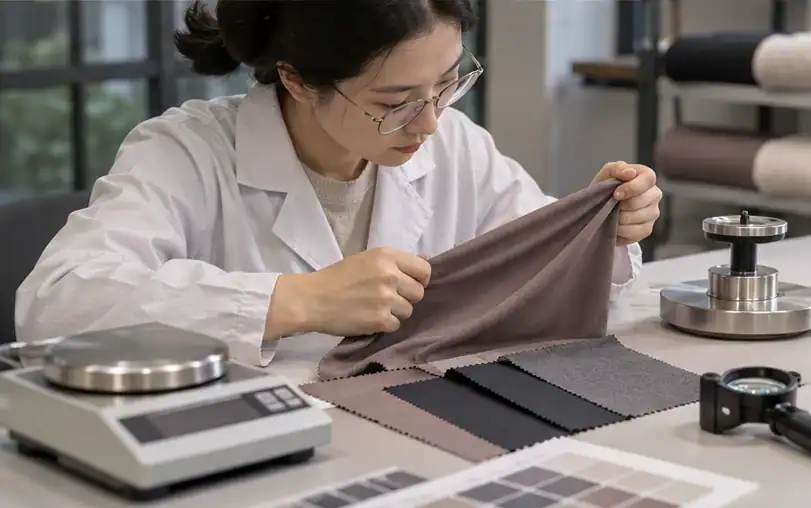
Send your sketches or tech pack, target garment, fabric performance requirements, expected quantity, color options and delivery destination. Ask for a product-specific fabric shortlist, swatches, sample plan and quality criteria before bulk production.
Explore FreeFeel Gym WearEditorial note: material guidance is general and must be matched to actual textiles and test results. The GSM bands are exploratory—not mandatory specifications. FreeFeel's capacities, MOQ and lead times are company-provided references subject to confirmation. All images are reused AI-generated illustrations, not photographs of the factories or laboratory tests. Verify Ohsure links before publication.